

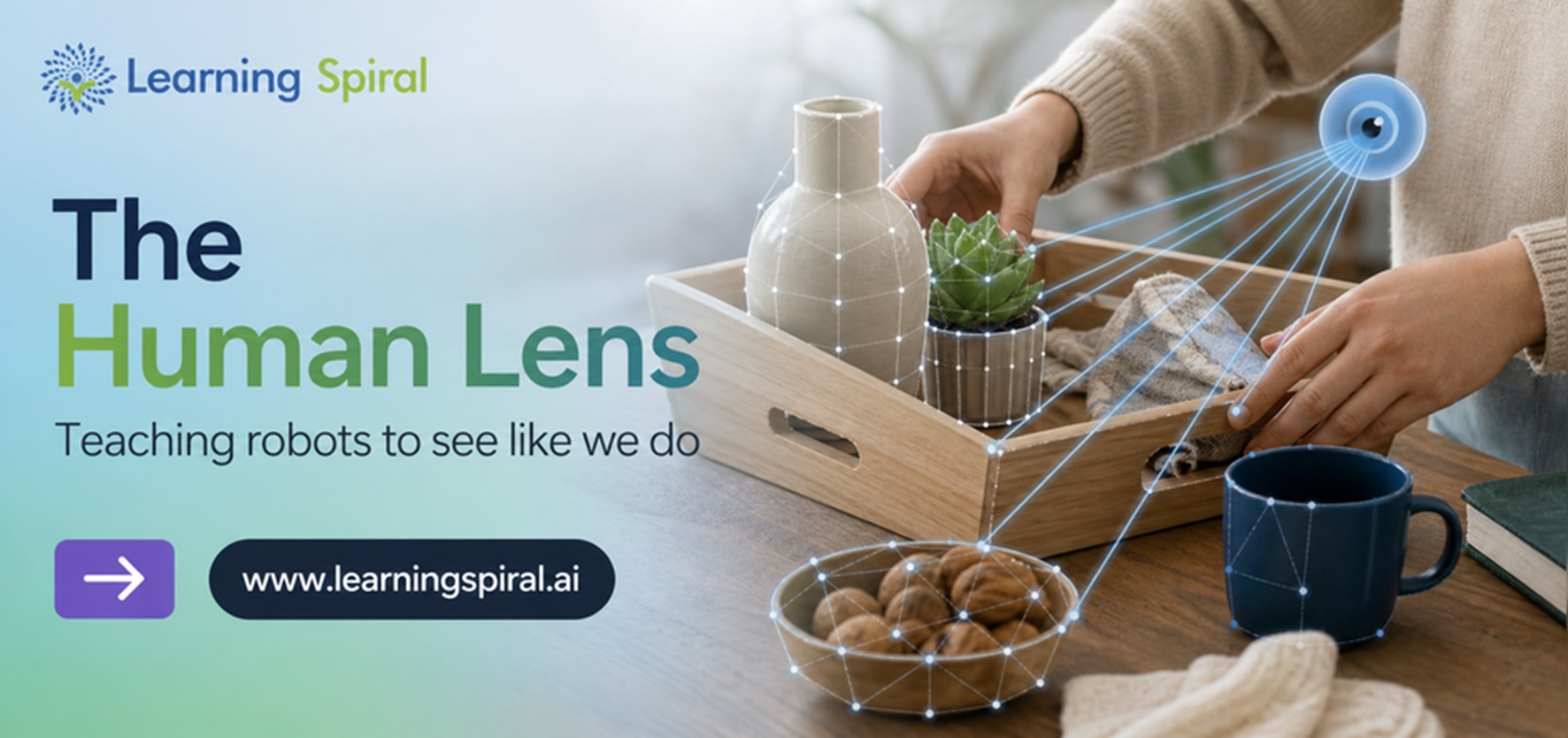
Imagine a robot entering a busy warehouse. It sees shelves filled with packages, workers moving between aisles, forklifts carrying goods and boxes scattered across the floor. Within seconds, it must identify objects, estimate distances, recognize potential hazards and decide where to move.
For humans, understanding such a scene feels almost effortless. For robots, it requires advanced perception systems, machine learning models and enormous amounts of accurately labeled training data.
A camera can capture an image, but it cannot automatically explain what that image means. This is where Data Annotation for Robotics becomes essential.
By combining human expertise with structured Data Labeling, artificial intelligence systems can learn to distinguish objects, interpret movements, understand spatial relationships and respond to complex environments.
At Learning Spiral AI, we help bridge the gap between raw visual information and machine understanding through specialized data annotation and AI training data services.
Why Seeing Is More Than Capturing an Image
Human vision is not simply about detecting colors and shapes. Our brains continuously interpret context, movement, distance and relationships between objects.
When a person sees a ball rolling toward a road, they understand that it is moving, may enter traffic and could be followed by a child.
A robot needs training to recognize these relationships.
The field of Computer Vision focuses on helping machines extract meaningful information from images, video and other visual inputs.
However, the real challenge is not merely recognizing an object. It is understanding the object within its surrounding environment.
For example, a robotic arm in a manufacturing facility must identify a component, determine its orientation, understand its position relative to other objects and grasp it without damaging nearby equipment.
Similarly, an autonomous mobile robot must distinguish between a stationary obstacle and a moving worker, even when both appear in its path.
These abilities depend on datasets containing accurate object labels, spatial information and relevant environmental context.
The Human Lens: How Data Annotation Teaches Robots to Understand
Robots do not automatically acquire human-like visual understanding. They learn statistical patterns from examples, training objectives and feedback.
Data Annotation transforms raw information into structured examples that AI systems can use during model development.
Consider a warehouse image containing a person, a pallet, several cartons and a forklift. Without annotation, these are simply pixels. With annotation, the same image can contain detailed information about object categories, positions, boundaries and interactions.
A trained model can then use similar visual patterns to identify objects in previously unseen environments.
Professional Image Annotation Services support this process through techniques such as bounding box annotation, polygon annotation, semantic segmentation, instance segmentation and keypoint labeling.
Bounding box annotation identifies an object’s approximate position. Semantic segmentation classifies image regions at the pixel level, while keypoint labeling helps systems learn important landmarks and object orientations.
Different annotation techniques address different robotics challenges. The right combination depends on whether the robot needs to recognize objects, navigate through an environment, manipulate components or understand human movement.
Why Human-in-the-Loop AI Matters for Robotics
One of the biggest challenges in robotics is that real-world environments rarely behave exactly as expected.
Lighting changes. Objects overlap. People move unpredictably. Transparent surfaces, reflections, unusual camera angles and unfamiliar objects introduce uncertainty.
Automated labeling tools can accelerate dataset preparation, but they can also make mistakes when situations become complex.
This is where Human in the Loop (HITL) becomes valuable.
Human-in-the-loop workflows combine automated predictions with human review, correction and feedback. Instead of treating machine-generated labels as automatically correct, trained annotators examine difficult cases and help improve training-data quality.
For example, an annotation model may incorrectly classify a partially hidden pallet as a storage box. A human reviewer can inspect the surrounding visual context and correct the label.
These corrections create more reliable training examples and can guide future improvements to the annotation process.
For robotics developers, HITL workflows are particularly useful when working with uncommon objects, visually ambiguous scenes, safety-relevant interactions and evolving environments.
Human oversight does not guarantee error-free robotic behavior, but it provides an important quality-control layer within the wider AI development process.
From Human Actions to Robotic Intelligence: Egocentric Data Collection
Watching a person perform a task provides information that a static image cannot capture.
Consider someone opening a drawer, selecting an object and placing it on a table. Understanding this activity requires more than identifying the drawer and the object.
A robot must learn the sequence of actions, the interaction between the hand and the object, and the changing positions of items throughout the task.
This is why Egocentric Data Collection is becoming increasingly relevant to robotics and Physical AI development.
Egocentric data typically captures activities from a first-person perspective, often using wearable or head-mounted cameras.
These recordings can provide information about how humans manipulate everyday objects, navigate environments and complete multi-step activities.
Through Video Annotation, action labeling, object tracking and temporal segmentation, human demonstrations can be organized into useful training datasets.
For example, a first-person video of a warehouse worker picking up a package may be annotated to identify the package, the hand-object interaction, the start and end of the picking action, and the final placement.
Such datasets can help researchers develop robotic perception and manipulation systems that learn from human behavior.
However, visual demonstrations alone are not always sufficient for robotic control. Additional information such as depth, force, robot state or action trajectories may be needed depending on the application.
Why Robots Need Depth Perception and LiDAR Annotation
Recognizing an object is only one part of robotic vision. Robots must also understand where objects exist in three-dimensional space.
Imagine a robot identifying a chair in front of it. Knowing that the object is a chair does not reveal its exact distance, width or position relative to the robot.
This is where depth sensing, LiDAR Annotation and 3D Point Cloud Annotation become important.
LiDAR sensors measure distances and produce spatial point clouds representing the surrounding environment.
Through annotation, these points can be assigned meaningful labels such as vehicle, pedestrian, wall, shelf, road surface or obstacle.
Accurate LiDAR Annotation can support the development of perception models used in autonomous vehicles and robotic navigation.
Techniques such as 3D bounding boxes, point cloud segmentation and object tracking help organize complex spatial information into a Dataset for Machine Learning.
Robotics systems may also combine camera images and depth data to better interpret their surroundings.
By combining visual appearance with spatial measurements, AI models can develop a richer representation of objects and their positions.
How Video Annotation Helps Robots Understand Movement
A single image captures one moment. Real-world robotics requires understanding what happens before, during and after that moment.
A delivery robot moving through a crowded building must recognize whether a person is walking toward it, moving away or standing still.
Video Annotation provides training examples for these kinds of tasks.
Object tracking helps models associate the same object across consecutive frames. Action labeling identifies meaningful activities, while temporal annotation records when events begin and end.
For robotic systems, these techniques are relevant to motion analysis, human-robot interaction, activity recognition and dynamic obstacle detection.
Video annotation can also help teams examine how objects behave under different conditions, including changes in lighting, partial visibility and camera motion.
When combined with Image Labeling and spatial annotation, video datasets provide a broader foundation for developing intelligent robotic perception.
Where Human-Centered Robotic Vision Creates Real-World Value
The impact of robotic perception extends beyond research laboratories.
In warehouses and logistics facilities, robots can use object detection, scene understanding and spatial perception to support package handling, navigation and inventory-related tasks.
In agriculture, annotated images can help AI models distinguish crops from weeds, identify certain visible crop conditions and support automated field operations.
Manufacturing environments use robotic vision for component identification, quality inspection and positioning tasks that require consistent object recognition.
Autonomous vehicles depend on visual perception, LiDAR data and temporal tracking to interpret roads, vehicles, pedestrians and surrounding infrastructure.
Healthcare robotics may use carefully governed visual and spatial data to support selected assistance or procedural applications, subject to rigorous validation and privacy safeguards.
The study of Perceptual Robotics also explores how principles of human and biological perception can inform robotic design.
Across these applications, one fundamental requirement remains consistent: training data must reflect the environments, objects and conditions that robots will encounter.
The Importance of High-Quality Datasets for Machine Learning
More training data does not automatically produce better AI models.
A dataset containing thousands of inconsistent labels, duplicated examples or missing edge cases can introduce weaknesses into model training.
Effective AI Training Data Services therefore focus on both data quantity and data quality.
A well-designed annotation workflow begins with clear labeling instructions and consistent class definitions. Annotators need to understand how to handle overlapping objects, partially visible items, unusual perspectives and ambiguous scenarios.
Quality assurance may involve multiple stages of review, sampling, correction and feedback.
Dataset diversity is equally important. A robot trained only on brightly lit warehouse images may struggle when deployed in dimly lit storage areas.
Teams should evaluate whether their datasets represent relevant lighting conditions, camera perspectives, object variations and operational environments.
For safety-relevant applications, dataset preparation must also work alongside independent testing, model validation and appropriate operational safeguards.
Ultimately, successful data annotation projects are built around the intended use of the AI system rather than annotation volume alone.
How Learning Spiral AI Supports Smarter Robotic Vision
Learning Spiral AI is a Data Annotation Company supporting organizations that need structured training data for machine learning and computer vision applications.
Our services include image annotation, video annotation, object tracking, bounding box annotation, segmentation and other specialized labeling workflows for AI development.
For robotics applications, we support the preparation of visual training data that helps models recognize objects, interpret scenes and learn from real-world environments.
Our broader service capabilities also include data labeling solutions relevant to autonomous mobility, spatial perception and Physical AI.
As an experienced Data Labeling Company in India, Learning Spiral AI emphasizes human expertise, scalable annotation workflows and quality-focused delivery.
Our AI Training Data Services help organizations transform raw visual data into structured resources for model development.
Whether a project involves Image Annotation for Robotics, warehouse automation, 3D Point Cloud Annotation or human activity understanding, defining the correct annotation methodology is essential.
We work with teams to understand their requirements, establish labeling guidelines and support data preparation workflows that align with their AI development objectives.
The Future of Robotic Vision: Beyond Object Recognition
The next generation of robotics will demand more than the ability to identify familiar objects.
Robots will increasingly need to interpret human actions, reason about spatial relationships and respond to environments that change over time.
Developments in multimodal learning, embodied AI and Physical AI are creating new opportunities to combine visual data with language, depth, motion and action information.
For example, a future household robot may need to understand the instruction “place the cup beside the plate,” identify both objects, determine a suitable placement and perform the action safely.
Such capabilities require more than computer vision alone. They involve integrating perception with language understanding, planning, control and continual evaluation.
High-quality Data Labeling Services and human-reviewed training datasets will remain important components of this broader development process.
The goal is not to make robots perceive the world exactly as humans do, but to give them the information and capabilities needed to operate more effectively in human environments.
Human Expertise Helps Build Smarter Machine Vision
Teaching robots to see like humans begins with understanding what visual intelligence truly requires.
It is not enough for a machine to capture images. It must learn to recognize meaningful patterns, interpret its surroundings and respond appropriately to the information it receives.
Image Annotation, Video Annotation, LiDAR Annotation and Human-in-the-Loop workflows help convert raw observations into the structured examples used to develop these capabilities.
As robotics becomes more integrated into manufacturing, logistics, agriculture and everyday life, carefully prepared AI training data will continue to play an important role in advancing robotic perception.
At Learning Spiral AI, we help turn complex data into meaningful training resources for intelligent machines.
Looking to develop a high-quality dataset for your robotics or computer vision project?
Connect with Learning Spiral AI to discuss your data annotation and labeling requirements.
