

NLP & Language Data
What Our Service Helps You Achieve
Language AI relies on structured examples of words, entities, intent, sentiment, dialogue and speech. It must deal with ambiguity, informal expression, multilingual content and changing domain vocabulary. For an AI product team, the value is not merely that assets have labels or that a collection has reached a certain size. The value is whether those assets teach the model the distinctions it needs to make in production. Learning Spiral AI approaches text annotation as an operational service: we connect project objectives, task instructions, trained people and measurable review decisions so the resulting data can be used rather than repeatedly repaired.
Our clients may begin with raw data, partially labeled files, a proof of concept or an established pipeline that needs extra capacity. In each case, we first clarify the intended decision, the relevant environments and the required level of detail. That lets our team avoid a one-size-fits-all annotation specification. We can work within an existing client workflow or help organize the collection, labeling and review stages into a managed delivery programme.
What This Service Covers
NLP & Language Data supports teams that need consistent information about language, domain vocabulary and the model’s decision task. The right task definition determines the level of labeling, how exceptions are treated and what downstream models can learn. An uncomplicated label is suitable in some settings; in others, the difference between two similar classes, an exact boundary or a timestamp is the information that matters most. The scope is therefore chosen around the intended use, not around the largest possible list of annotation features.
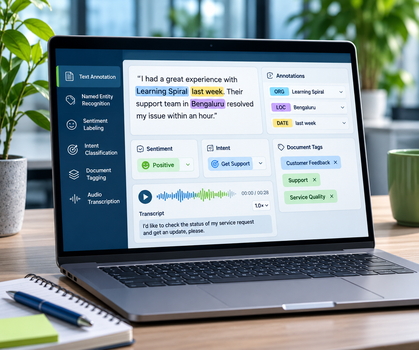
- Text annotation for classification, named entities, spans, relations, sentiment, intent and attributes.
- Conversational data, dialogue turns, slots, fallback intents and project-defined evaluation labels.
- Audio transcription, validation and speech-related annotation where required, including multilingual scopes.
Where appropriate, this service can connect with NLP data annotation, audio annotation and named entity recognition. Each capability supplies a different kind of evidence that a model or business system may need. During scoping, we decide which deliverables are essential, which can be deferred and which require specialist reviewer knowledge.
Projects may also need intent analysis alongside sentiment analysis, depending on the modality and business objective. Where human in the loop is relevant, we treat it as part of the same client-approved brief rather than a disconnected workstream. This helps engineers receive compatible labels, definitions and review notes when data moves between teams or systems.
Designed Around Your Objective, Not a Generic Template
At Learning Spiral AI, we start by asking what an acceptable model outcome looks like, what source material is available and what currently causes errors. We map the data requirements to practical rules that a trained annotator can apply consistently. Those rules specify what should be included, what should be excluded, what counts as an uncertain example and who approves a disputed judgment. This turns an abstract AI goal into a repeatable process that a dedicated team can execute.
For NLP & language data, we would normally review a small representative sample before recommending full production. The sample helps establish expected difficulty, output granularity, review effort and the exceptions that make the task different from ordinary labeling. A client can supply approved gold examples, or we can help develop a first reference set for sign-off. The agreed specification becomes the common language between the client, project manager, annotators and quality reviewers.
How Our Delivery Team Works
We use a pilot-first operating model so your team can evaluate output quality before expanding volume. The first stage is requirements translation: the Learning Spiral AI team captures language, domain vocabulary and the model’s decision task and identifies the decisions that need reviewer judgment. We turn them into examples, edge-case instructions and checklists. Rather than expecting annotators to infer unspoken requirements, we establish shared interpretations using approved samples.
- We begin with the language task and target use cases, defining examples that distinguish near-identical intents or entity categories.
- Our annotation leads turn the specification into a clear manual, evaluate a pilot and train a suitable team on domain-specific vocabulary.
- Human reviewers adjudicate ambiguous phrases, code-switching, sarcasm and inconsistent entity boundaries while feedback is captured in updated guidance.
- We deliver structured datasets that align with your model or application needs, including correction rounds based on downstream error analysis.
Following the pilot, work can be organized into controlled batches with a dedicated team, clear internal ownership and scheduled client feedback. Learning Spiral AI publicly describes its delivery model as in-house, trained and scalable; for a specific engagement, staffing and review levels are matched to the agreed volume and complexity. If throughput must change, we focus first on calibration and documentation so additional capacity does not create inconsistent labels.

Accuracy and Quality Are Designed into the Workflow
For text annotation, accuracy has to be defined against the task. A useful quality plan makes its checks observable: intent agreement, entity spans, transcript alignment and domain-label consistency. A blanket percentage without a dataset definition would hide important errors. Instead, we propose agreeing the acceptance criteria, reviewing representative examples and distinguishing errors by severity. The target may concern geometry, class assignment, sequence continuity, policy decisions or metadata completeness, depending on the service.
Quality checks focus on label agreement, span boundaries, intent confusion, speaker or turn attribution, transcripts and language-specific edge cases. For sensitive subject matter, expertise and review responsibilities are agreed in advance rather than assumed.
Our quality workflow can combine annotator self-checks, independent review, targeted audits and adjudication of disputed cases. Reviewers pay particular attention to span offsets, context, ambiguity and inter-annotator agreement. If automated suggestions or model-assisted pre-labels are used, trained people verify them against the specification; uncertainty is not treated as truth simply because a model produced a confident answer. We can sample routine cases while increasing review attention on new classes, rare examples or error-prone batches, as agreed with the client.

Handling Difficult and Unusual Cases
The cases that most often affect model performance are not always the most common. Consider this project illustration: A support assistant receives messages containing abbreviations, code-mixed language, audio requests and incomplete sentences. The difficulty is that the same utterance can mean a complaint or a neutral question depending on tone and history. Our team can use such scenarios to test instructions in the pilot, reserve senior-review time for difficult material and identify which conditions are missing from the data already available.
We define an exception path before volume increases. Annotators flag examples that lack enough evidence, conflict with the taxonomy or fall outside the approved brief. Reviewers then resolve them where the rule is established and escalate remaining cases to the client’s subject-matter expert. This avoids quiet guessing, creates an auditable set of decisions and supplies useful examples for the next version of the guidelines. For especially ambiguous material, we can record an explicit uncertainty or exclusion outcome if the project schema allows it.
Outputs That Fit Your Training Pipeline
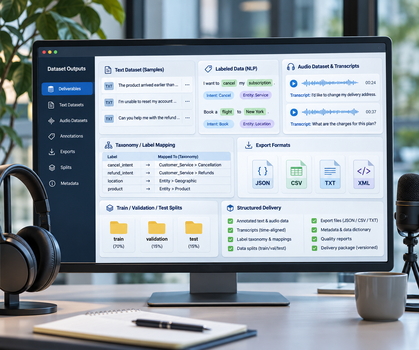
Useful service delivery includes more than a file archive. Learning Spiral AI can align the data handoff to the client’s approved schema and tooling, including text spans, audio transcripts, intents, sentiment and structured language labels. File and annotation IDs, class names, source references and batch metadata must remain consistent with the model pipeline. We validate representative exports during the pilot so that import failures, unsupported category names or missing context are not discovered after the whole dataset is produced.
Before each approved delivery, our team can check manifest completeness, output schema, naming conventions, expected record counts, unresolved queries and agreed exception flags. A concise handoff summary can identify what was delivered, which guidelines were used, what review was performed and what needs client clarification. The result is more useful to NLP and speech product teams than an unexplained folder of files, because the data remains traceable when experiments are repeated or new versions are trained.
Where Learning Spiral AI Can Support Your Team
Our engagement can begin at the point that creates the most friction. Some organizations need assistance defining a taxonomy; others already have clear rules and mainly need dependable execution capacity. A third group has model errors and needs specific data corrected or collected. Learning Spiral AI can support these needs without assuming that every client should rebuild its entire pipeline. We can connect project management, trained annotation staff and quality reviewers to your existing engineering milestones.
Develop Gold Examples
Develop gold examples for a new NLP classifier or conversational model.
Scale Text and Speech
Scale text and speech labeling while retaining terminology consistency.
Improve Model Labels
Review low-confidence machine labels and create challenge sets for model improvement.
A Realistic Application Example
A support assistant receives messages containing abbreviations, code-mixed language, audio requests and incomplete sentences. A sensible first milestone would be a representative sample containing ordinary situations and deliberately selected hard cases. We would ask NLP and speech product teams to confirm which distinctions matter, prepare the annotation or capture specification, complete the pilot and compare the output with the agreed acceptance examples. Only then would the project move to larger batches. This keeps decisions grounded in examples the client has actually approved.
The next stage would respond to queries the model misunderstands. Instead of adding more random data, Learning Spiral AI can help identify which samples, categories or contexts deserve another round of collection, labeling or QA. That allows the dataset to evolve alongside the model. Learning Spiral AI offers trained in-house teams, language-data labeling and human-in-the-loop review across text and audio operations.
Security, Communication and Scalable Collaboration
Learning Spiral AI describes its organization as ISO 27001-compliant and highlights experience handling sensitive data. Individual project safeguards still need to be agreed: who is permitted to access the files, what confidentiality or NDA terms apply, whether personal information is present, how transfers work, what may be retained and when material must be deleted. We do not assume that a generic policy replaces the controls required by a specific customer or industry.
We aim to make delivery predictable through a dedicated project contact, structured queries and documented approvals. Our in-house workforce can be trained against client-specific tasks, while project managers monitor quality issues and evolving requirements. For a changing workload, batch sizing and staffing can be adjusted through an agreed ramp plan. The practical benefit is not just capacity; it is continuity of knowledge about your taxonomy, known exceptions and downstream data requirements.

What Sets Learning Spiral AI Apart
Learning Spiral AI combines human-led data operations, trained dedicated professionals, multimodal services and managed quality review. For NLP & language data, that means we can take responsibility for the details that often fall between an ML team’s requirements and a production labeling queue: guideline design, annotator calibration, exception handling, reviewer feedback and final data readiness. Our approach is designed for long-term consistency while keeping the client in control of specifications and acceptance.
Contact Us →
Frequently Asked Questions
Can you work with our specific entities or intents?
Yes, we build guidance around your schema.
Can you handle multilingual projects?
Yes, coverage and reviewer suitability are verified at scoping.
How is text annotation quality checked?
We define acceptance examples and task-specific checks, run a pilot, calibrate reviewers and review errors such as intent agreement, entity spans, transcript alignment and domain-label consistency. Any accuracy target must be agreed for the dataset.
Can your team work with our tools, taxonomy and output schema?
Yes, subject to technical scoping. We can review your categories, sample files and export needs and validate the proposed handoff in a representative pilot.
Can we begin with a limited pilot instead of a large engagement?
Yes. A scoped pilot is useful for confirming edge cases, review effort, practical throughput and acceptance criteria before a larger production programme.
Discuss Your Data Requirement with Our Team
If your team is evaluating text annotation, share a sample, your target model task and the most difficult decisions the data must support. Learning Spiral AI can help scope a pilot with clear guidelines, a review plan and an agreed delivery format.
humans@learningspiral.ai | +91 722 4061 676 | learningspiral.ai
Contact Us →