

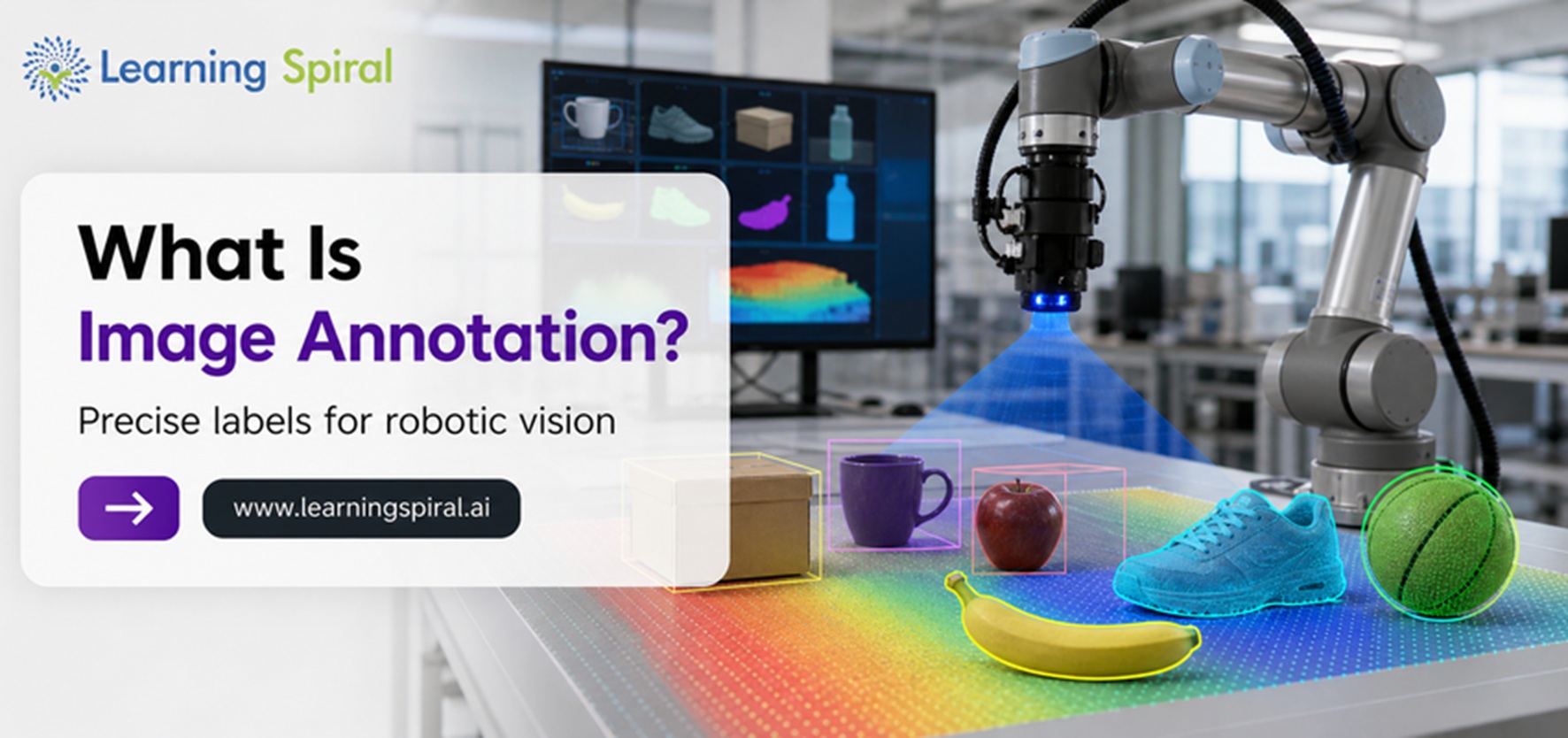
Robots do not understand their surroundings in the way humans do. A camera may capture a factory floor, warehouse aisle, road, crop field, or operating room, but the robot still needs to identify what it sees and determine how to respond. This is where image annotation for robotics becomes essential.
Image annotation converts raw images and video frames into structured training data. By labeling objects, boundaries, movements, surfaces, and spatial relationships, it helps computer vision models learn how to perceive and interact with real-world environments.
What Is Image Annotation for Robotics?
Image annotation for robotics is the process of labeling visual data so that machine learning models can recognize objects, people, obstacles, actions, and environmental features.
For example, an image captured by a warehouse robot may be annotated to identify:
- Workers
- Shelves and storage racks
- Packages and pallets
- Forklifts and other robots
- Free navigation paths
- Restricted or hazardous areas
These annotations act as a reference during model training. Over time, the robotic vision system learns to detect similar elements in new, previously unseen environments.
Why Do Robots Need Annotated Images?
A robot must do more than capture visual information. It must interpret that information accurately enough to make safe, timely decisions.
High-quality annotated data can help robots:
- Detect and classify objects
- Navigate around obstacles
- Estimate the position of an item
- Recognize human actions and gestures
- Pick, place, sort, or assemble components
- Inspect products for defects
- Adapt to changes in lighting, angle, scale, and background
Without reliable annotation, a model may confuse visually similar objects, overlook hazards, or perform poorly outside controlled testing conditions. In robotics, these errors can affect safety as well as operational performance.
How Image Annotation Supports Robotic Vision
The development process generally follows a structured sequence:
- Visual data collection: Images or videos are captured using robot-mounted cameras, depth sensors, drones, or fixed monitoring systems.
- Data annotation: Relevant objects and environmental features are labeled according to detailed project guidelines.
- Quality assurance: Annotated data is reviewed for accuracy, consistency, and completeness.
- Model training: The labeled dataset is used to train a computer vision model.
- Validation and testing: The model is evaluated using unfamiliar data and real-world scenarios.
- Continuous improvement: Difficult cases are collected, annotated, and added to the training dataset.
This cycle allows robotic systems to improve as they encounter new environments and edge cases.
Common Types of Image Annotation in Robotics
The right annotation method depends on what the robot needs to perceive and how precisely it must interact with its surroundings.
1. Bounding Box Annotation
Bounding boxes are rectangular labels placed around objects. They are commonly used to train object-detection models to identify people, packages, vehicles, tools, or machinery.
This method is efficient and useful when the system needs to know what an object is and approximately where it is located.
2. Polygon Annotation
Polygon annotation traces the detailed shape of an object. It is helpful for irregular items that cannot be represented accurately with a simple rectangle, such as machine components, damaged areas, or overlapping objects.
3. Semantic Segmentation
Semantic segmentation assigns a class to every relevant pixel in an image. It can distinguish floors, walls, roads, vegetation, machinery, people, and other surfaces.
For navigation robots, this creates a detailed understanding of which areas are safe, blocked, or restricted.
4. Instance Segmentation
Instance segmentation identifies each object separately, even when several objects belong to the same category. A warehouse robot, for example, can distinguish one package from another within a stack.
This level of detail is valuable for robotic picking, sorting, counting, and manipulation.
5. Keypoint and Landmark Annotation
Keypoints mark important positions on an object or body, such as human joints, tool corners, or robotic arm components. They support pose estimation, gesture recognition, movement analysis, and human–robot collaboration.
6. 3D Cuboid Annotation
Three-dimensional cuboids represent an object’s height, width, depth, position, and orientation. They are used when a robot must understand spatial relationships and plan movement in three-dimensional environments.
7. Polyline Annotation
Polylines label linear features such as road boundaries, cables, pipelines, tracks, or navigation routes. They can help mobile robots and autonomous machines follow defined paths.
8. Video Annotation and Object Tracking
Video annotation labels objects across consecutive frames. It helps models understand direction, speed, movement, and interaction over time—critical information for robots operating in dynamic environments.
Key Applications of Image Annotation for Robotics
Industrial and Manufacturing Robots
Annotated data helps industrial robots locate components, guide robotic arms, monitor assembly operations, and identify product defects. Precise labeling is particularly important when objects are small, reflective, partially hidden, or closely packed.
Warehouse and Logistics Automation
Warehouse robots use computer vision to identify packages, read storage environments, avoid people and equipment, and select safe travel paths. Annotation supports picking, sorting, inventory movement, and last-mile delivery systems.
Autonomous Vehicles and Mobile Robots
Self-driving platforms and delivery robots must recognize pedestrians, vehicles, road boundaries, signs, obstacles, and navigable areas. Diverse, accurately annotated visual data helps these systems perform across different locations, weather conditions, and lighting environments.
Agricultural Robotics
Agricultural robots can use annotated images to distinguish crops from weeds, detect disease symptoms, estimate fruit maturity, and guide automated harvesting or spraying equipment.
Healthcare and Assistive Robotics
Medical and assistive robots may need to recognize instruments, monitor movement, understand gestures, or navigate clinical environments. Annotation quality and data privacy are especially important in these sensitive applications.
Drones and Inspection Robots
Drones and inspection robots analyze visual data from infrastructure, power lines, pipelines, factories, and construction sites. Annotated datasets help them detect cracks, corrosion, missing components, surface damage, and other abnormalities.
Challenges in Annotating Robotics Data
Robotics datasets often involve greater complexity than standard image-classification projects. Common challenges include:
- Occlusion: Objects may be partly hidden behind people, equipment, or other items.
- Motion blur: Moving robots or objects can reduce image clarity.
- Changing conditions: Lighting, weather, camera angle, and background can vary significantly.
- Fine object boundaries: Accurate robotic manipulation may require pixel-level precision.
- Rare safety events: Dangerous situations may occur infrequently but remain essential for model training.
- Class ambiguity: Visually similar objects may require careful distinction.
- Large data volumes: Video-based projects can contain millions of frames.
- Sensor alignment: Camera, depth, and other sensor data may need synchronized annotation.
These challenges make clear guidelines, trained annotators, and multi-stage quality checks essential.
Best Practices for High-Quality Robotics Annotation
Define the Robot’s Task First
Annotation should be designed around the decision the robot needs to make. A navigation robot, for instance, requires different labels from a robotic arm sorting small components.
Create Detailed Annotation Guidelines
Guidelines should explain label definitions, boundary rules, occlusion handling, difficult examples, and class hierarchies. Consistent instructions reduce variation among annotators.
Include Real-World Diversity
Datasets should reflect the environments in which the robot will operate. This includes differences in lighting, viewpoint, object size, background, weather, location, and human behavior.
Prioritize Edge Cases
Unusual objects, crowded scenes, partial visibility, reflections, and rare events often reveal model weaknesses. Including these cases can improve real-world reliability.
Use Layered Quality Assurance
Annotation quality should be measured through reviewer checks, consensus reviews, automated validation, and sample audits. High-risk classes may require stricter acceptance thresholds.
Maintain Data Security
Robotics data may contain people, private facilities, industrial processes, or sensitive assets. Secure access controls, confidentiality procedures, and responsible data handling should be built into the workflow.
Continuously Update the Dataset
Robotic environments change. New objects, layouts, behaviors, and operating conditions should be added through an ongoing feedback and re-annotation process.
The Role of Human Expertise in Robotics Training Data
Automation can speed up pre-labeling and identify obvious annotation errors, but human judgment remains important. Skilled annotators can interpret ambiguous scenes, apply context-sensitive guidelines, and distinguish cases that automated tools may overlook.
A human-in-the-loop workflow combines machine-assisted annotation with expert review. This approach can improve efficiency while maintaining the accuracy required for real-world robotic systems.
How to Choose an Image Annotation Partner for Robotics
Before selecting a data annotation provider, evaluate whether the team can offer:
- Experience with computer vision and robotics datasets
- Support for bounding boxes, polygons, segmentation, keypoints, tracking, and 3D annotation
- Scalable teams and flexible workflows
- Clear quality metrics and review processes
- Secure data-handling practices
- Custom annotation guidelines and ontology development
- Support for pilot projects and iterative dataset improvement
The lowest-cost annotation option may not provide the consistency needed for safety-critical or precision-focused robotic applications. Quality, scalability, domain understanding, and communication should be considered together.
Conclusion
Image annotation for robotics gives machines the labeled visual examples they need to understand and respond to their surroundings. From detecting warehouse packages to guiding industrial arms and navigating autonomous platforms, accurate annotation forms the foundation of dependable robotic vision.
However, strong results depend on more than drawing labels. The dataset must reflect real operating conditions, include difficult edge cases, follow consistent guidelines, and pass rigorous quality checks.
Learning Spiral AI supports robotics and computer vision initiatives with scalable image and video annotation workflows tailored to specific use cases. With carefully designed processes, trained teams, and multi-level quality assurance, organizations can build more relevant training datasets for reliable real-world performance.
Looking to prepare high-quality visual training data for your robotics project? Connect with Learning Spiral AI to discuss a customized annotation workflow.
Frequently Asked Questions
What is image annotation in robotics?
It is the process of labeling objects, surfaces, movements, and other visual elements in images or videos so robotic computer vision models can learn to interpret their surroundings.
Which annotation type is best for robotic vision?
It depends on the task. Bounding boxes suit general object detection, segmentation provides precise boundaries, keypoints support pose estimation, and 3D cuboids help with spatial understanding.
How does annotation improve robot accuracy?
Accurate, consistent labels give the model dependable examples from which to learn. Diverse datasets and edge-case annotations further improve performance in unfamiliar real-world situations.
Can image annotation be automated?
Some annotation can be accelerated through model-assisted pre-labeling. Human review is still important for ambiguous scenes, precise boundaries, rare cases, and quality assurance.
Why is data diversity important for robotics?
Robots encounter different objects, people, locations, lighting conditions, and viewpoints. Diverse training data reduces blind spots and improves the model’s ability to generalize.
