

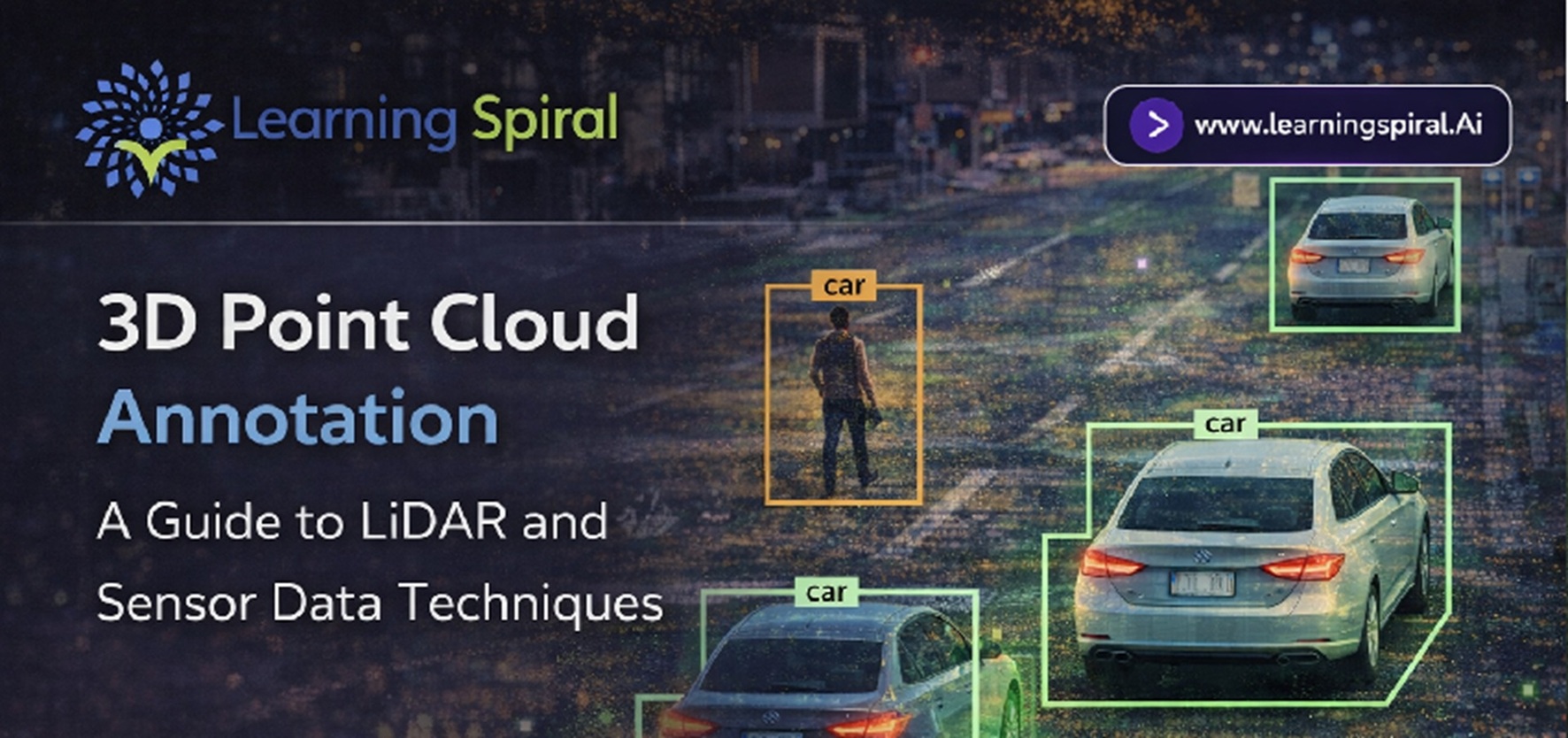
The rise of autonomous vehicles, industrial robotics, and smart infrastructure has created an urgent demand for one thing: precise, high-quality spatial data. LiDAR sensors generate millions of data points per second, producing what engineers call a “point cloud” — a dense 3D map of the physical world. But raw data alone doesn’t teach machines. Accurate annotation does.
3D point cloud annotation is the process of labeling objects, surfaces, and spatial relationships within LiDAR-captured environments. It is the foundation of reliable computer vision systems and a non-negotiable step in building effective machine learning datasets for real-world deployment.
What is 3D point cloud annotation?
Unlike traditional 2D image annotation, point cloud annotation operates in three-dimensional space. Annotators — and increasingly, AI-assisted tools — must identify and label objects like pedestrians, vehicles, road signs, and barriers across X, Y, and Z axes simultaneously.
This requires a combination of image annotation services, sensor fusion techniques, and expert human review to ensure spatial accuracy. Even minor labeling errors can have serious downstream consequences in safety-critical applications such as autonomous driving and UAV navigation.
Core annotation techniques for LiDAR data
1. 3D bounding box annotation
The most widely used technique, 3D bounding boxes encapsulate objects within a six-sided cuboid. Each box carries attributes such as object class, orientation, and velocity — essential for training perception models in autonomous systems.
2. Semantic segmentation
Every individual point in the cloud is assigned a semantic label (road, building, tree, vehicle). This granularity is critical for creating AI data solutions that support detailed environmental understanding in robotics and smart city platforms.
3. Instance segmentation
Going a step further, instance segmentation distinguishes between individual objects of the same class — for example, separating each pedestrian in a crowd as a distinct labeled entity. This supports more nuanced model behaviour in dynamic, real-world scenarios.
4. Polyline and polygon annotation
Used for road lane markings, curbs, and boundaries, polyline annotation helps autonomous systems understand drivable and non-drivable zones with high precision.
5. Sensor fusion annotation
Combining LiDAR point clouds with video annotation and camera data creates richer, multi-modal datasets. Sensor fusion allows annotators to cross-validate labels across modalities — significantly improving dataset reliability for complex AI pipelines.
Why annotation quality defines model performance
High-quality annotation is not just data — it is the foundation of reliable AI systems. A model trained on poorly labeled point clouds will struggle to generalize in production environments, regardless of architecture complexity or compute power.
Organizations working with experienced data annotation companies consistently achieve faster model accuracy milestones and smoother deployment cycles. Scalable annotation workflows, backed by domain expertise and rigorous quality control, reduce iteration time and lower the cost of retraining.
Learning Spiral AI has developed annotation pipelines that combine skilled human annotators with AI-assisted tooling — designed specifically to handle the volume, velocity, and variety of modern LiDAR and sensor datasets. Their approach to data labeling is calibrated for the demands of automotive, robotics, and geospatial AI development.
Industry applications driving demand
- Autonomous vehicles — Real-time object detection, lane awareness, and collision avoidance
- Industrial robotics — Workspace mapping, object grasping, and safety zone enforcement
- Smart infrastructure — Traffic flow analysis, urban planning, and pedestrian safety
- Agriculture — Crop monitoring, terrain mapping, and autonomous equipment guidance
- Construction and mining — Site surveying, volumetric analysis, and equipment tracking
The role of a reliable data annotation partner
As AI projects scale, annotation bottlenecks become a primary constraint on time-to-deployment. Teams that attempt to manage annotation entirely in-house often face consistency issues, workforce limitations, and delayed labeling cycles.
Partnering with a dedicated data annotation company with proven expertise in 3D and multi-modal annotation removes these friction points. Learning Spiral AI offers end-to-end annotation support — from initial data ingestion through quality assurance — enabling AI teams to focus on model development rather than data management.
Whether your pipeline requires text annotation, audio annotation, or complex spatial labeling, working with a scalable and reliable partner accelerates the path from raw sensor data to production-ready AI.
Ready to accelerate your AI data pipeline? Explore Learning Spiral AI’s annotation services — from 3D point cloud labeling to full-spectrum AI data solutions. Learn more →
