

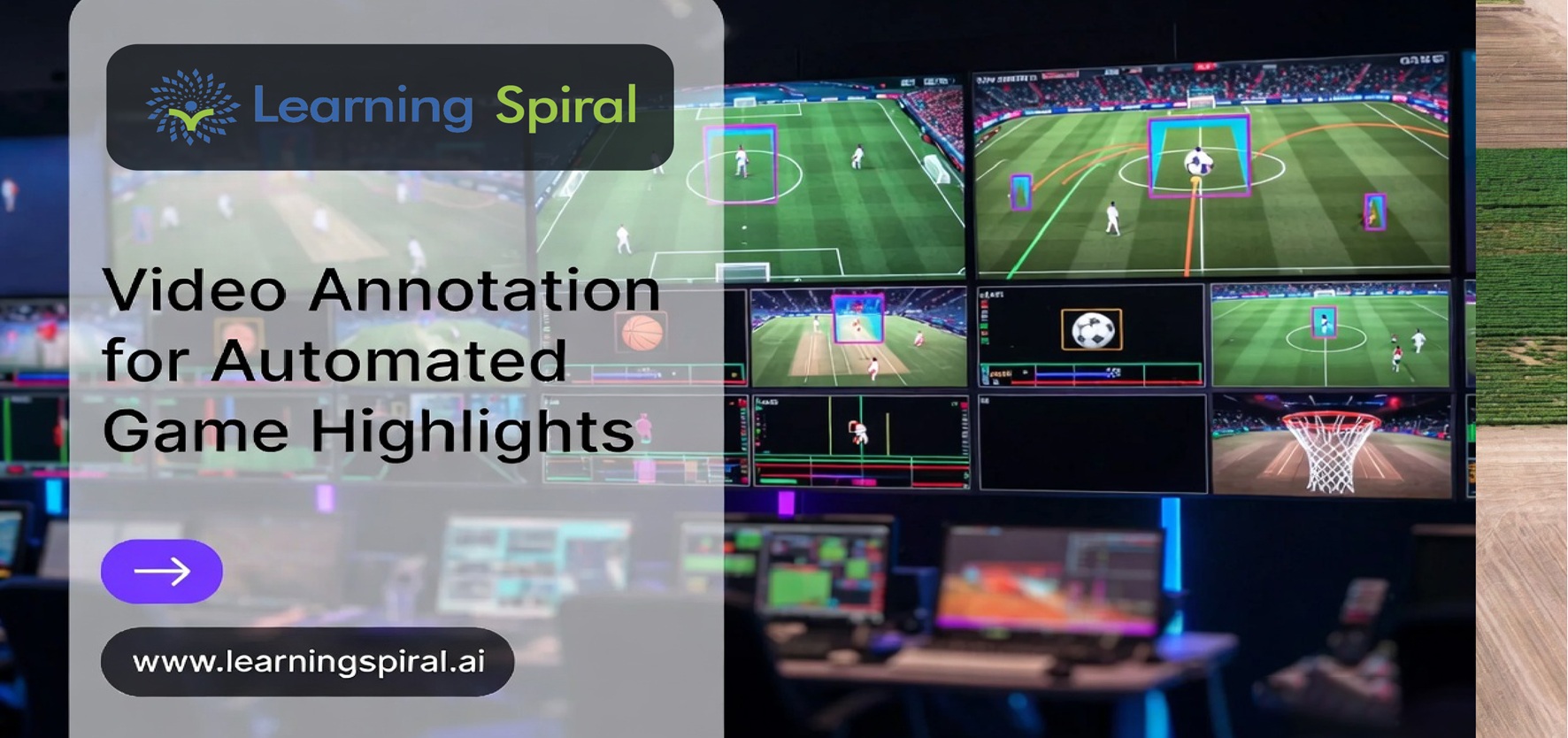
A single 90-minute football match produces roughly 150,000 video frames. A basketball game, with faster cuts, multiple camera angles, and constant substitutions, can generate an even higher frame count per minute of play. Somewhere inside that footage is the three-to-five-second moment a broadcaster, a league, or a fan actually cares about — the goal, the buzzer-beater, the perfectly timed tackle.
Finding that moment manually means an editor scrubbing through hours of footage, marking timestamps by hand, and cutting clips one at a time. For a single match, that’s a few hours of work. For a league running hundreds of fixtures a season across multiple age groups, divisions, or camera feeds, manual editing simply doesn’t scale — and it gets more expensive, not less, as coverage grows.
This is precisely the problem automated game highlight systems are built to solve. Computer vision models watch the footage, detect the events that matter, and generate the clip automatically — often within seconds of the play happening, sometimes fast enough to hit a fan’s phone before the crowd has stopped celebrating.
But here’s the part of the story that rarely gets discussed publicly: none of this works without properly annotated video. A model has no innate concept of what a “goal” looks like. It learns that concept only after being shown thousands of correctly labeled examples — goals, near-misses, celebrations, replays, and disallowed goals that look almost identical to real ones. The highlight engine is only ever as reliable as the video annotation that trained it.
This article breaks down exactly how that annotation process works, the specific techniques involved, where most highlight-detection projects go wrong, and what to look for when evaluating a partner to build this pipeline for you.
Why Automated Highlights Are Harder Than They Look
Sports video is one of the most demanding categories in computer vision, and it’s worth understanding why before jumping into a build:
- Fast, continuous motion — players, the ball, and the camera itself are all moving simultaneously, often at high speed, within the same frame
- Occlusion — a player, ball, or puck is frequently blocked from view by other players, referees, coaching staff, or equipment
- Frequent camera changes — broadcast feeds cut between wide shots, close-ups, replays, and crowd reaction shots within seconds, sometimes mid-action
- Sport-specific event definitions — a “highlight-worthy” moment in cricket (a wicket) has no visual equivalent in tennis (an ace) or esports (a clutch elimination), so a model trained on one sport rarely transfers cleanly to another
- Severe class imbalance — a football match might include 20+ shots on goal and only 2–3 actual goals; the model has to distinguish between them with precision, not approximation
- Lighting and venue variance — a day match, a floodlit night game, and an indoor arena all present different visual conditions for the same underlying sport
None of these problems are solved by throwing more compute at the model. They’re solved at the data layer — with annotation that is precise, consistent, and built around how the sport is actually played, not a generic template borrowed from another domain.
The Decision Framework: What Kind of Annotation Does Your Sport Need?
Before choosing an annotation approach, it helps to be honest about what your sport, footage, and product actually demand. Run through these questions:
| Ask Yourself | If Yes → | If No → |
|---|---|---|
| Does the sport involve fast, continuous player movement? | You need frame-by-frame object tracking | Simpler event tagging may suffice |
| Do multiple camera angles cover the same play? | Multi-camera annotation and player re-identification needed | Single-feed annotation is sufficient |
| Is the ball/puck/shuttle small and frequently occluded? | Prioritize high-frequency bounding box annotation | Lower frame-sampling rate works |
| Do you need highlights within seconds of the event? | Real-time-ready, low-latency annotated training data is essential | Batch annotation, processed post-match, is acceptable |
| Are you covering multiple sports or leagues? | You need scalable, standardized annotation pipelines with per-sport taxonomies | A single custom pipeline may work |
| Does the footage include lower-quality or non-broadcast camera feeds? | Annotators need extra training on degraded footage and edge cases | Standard broadcast-quality annotation guidelines apply |
Mostly “Yes” answers point toward a full frame-level, multi-technique annotation pipeline built for scale. A mixed set of answers suggests starting narrower — one sport, one camera feed, one event type — proving the pipeline works, and expanding from there rather than trying to solve every case on day one.
How Video Annotation Actually Powers Highlight Generation (Step by Step)
Automated highlight systems typically run on a chain of AI models, and each link in that chain depends on a different type of annotated training data:
- Object detection — identifying players, the ball, referees, and equipment in every frame. Taught using bounding box annotation across thousands of frames per sport.
- Player and object tracking — following the same player or ball continuously across a sequence of frames, even through camera cuts, rather than re-detecting them from scratch each time.
- Action recognition — classifying what’s actually happening (a shot, a tackle, a sprint, a serve). Taught using action-tagged video clips with precise start and end boundaries.
- Event detection — flagging the specific highlight-worthy moment (goal scored, foul called, boundary hit). Built on top of annotated event boundaries that mark the exact frame an event begins and ends.
- Clip generation and ranking — trimming the footage to the right start and end points around the labeled event, then optionally ranking multiple candidate clips by importance for auto-publishing.
If annotation quality breaks down at any one of these five stages — a bounding box drawn loosely, an action mislabeled, an event boundary marked half a second too late — the error compounds down the chain. A highlight reel that cuts off before the ball fully crosses the line isn’t a minor bug; it’s the entire product failing at the one job it exists to do.
This is why organizations building sports AI increasingly rely on structured annotation projects run by an experienced data annotation company, rather than in-house teams stretched across unrelated model work. Maintaining consistency across thousands of hours of footage, across multiple annotators, is a specialized discipline in its own right — not a side task.
Core Annotation Techniques Used in Sports Video
Bounding Box Annotation
The foundation of most sports computer vision pipelines. Bounding box annotation tracks players, the ball, referees, and equipment frame by frame, giving the model a spatial understanding of where everything is at any given moment. This is also the technique most sensitive to annotator inconsistency, since a box drawn a few pixels off, repeated across thousands of frames, teaches the model the wrong spatial boundaries.
Pose Estimation
Used to understand player posture and body movement — a raised arm for a foul appeal, a jump for a header, a low stance before a sprint. Pose data feeds directly into action recognition models and is particularly valuable for sports where the action is defined by body mechanics (gymnastics, athletics, combat sports) rather than ball movement alone.
Object Tracking Across Frames
Rather than annotating each frame in isolation, tracking annotation follows the same player or ball across a continuous sequence, which is essential for detecting actions that unfold over time — a dribble, a rally, a fast break, a counter-attack.
Event and Action Tagging
Marking the precise start and end timestamps of specific actions — a serve, a penalty kick, a slam dunk — so the model learns not just what an object is, but what is happening over a window of time, and exactly where that window begins and ends.
Multi-Camera Re-Identification
Broadcasts cut between camera angles constantly, sometimes several times within a single passage of play. Annotating the same player consistently across different camera feeds prevents the model from “losing” that player mid-play, which is critical for continuous highlight tracking during fast transitions.
3D Point Cloud and Depth-Based Annotation
For advanced setups using multi-camera arrays or depth sensors — increasingly common in professional stadiums — 3D point cloud annotation adds spatial depth to player and ball positioning, useful for offside detection, trajectory prediction, and advanced analytics layered on top of highlight generation.
Each of these techniques overlaps with broader computer vision work used across industries — the same underlying skill set behind image annotation for autonomous vehicles or image annotation for retail applies here, adapted for the speed, occlusion, and unpredictability specific to live sport.
Annotation Needs by Sport: A Quick Comparison
| Sport | Primary Challenge | Dominant Annotation Technique |
|---|---|---|
| Football / Soccer | Small, fast-moving ball; frequent occlusion | Bounding box + object tracking |
| Basketball | Rapid camera cuts, dense player clusters | Multi-camera re-identification + tracking |
| Cricket | Long idle periods punctuated by fast action | Event/action tagging with precise boundaries |
| Tennis | Repetitive, well-defined action units (serves, rallies) | Pose estimation + event tagging |
| Esports | Fully digital feed, in-game data available | Frame-level event tagging synced with game telemetry |
| Combat Sports | Body mechanics define the “moment” | Pose estimation |
This table is illustrative, not exhaustive — most production pipelines end up combining two or three of these techniques even within a single sport, since real footage rarely stays within one clean category for an entire match.
Common Pitfalls That Break Highlight Models
| Pitfall | Why It Happens | How to Avoid It |
|---|---|---|
| Inconsistent bounding boxes across annotators | Multiple annotators, no shared guideline | Use a documented annotation guideline with structured QA review |
| Missed occluded objects | Ball or player blocked mid-frame | Annotate through occlusion using motion-predicted boxes |
| Wrong event boundaries | Annotators mark the “obvious” moment, not the exact frame | Frame-accurate timestamping with a mandatory second-pass review |
| One-size-fits-all labeling across sports | Assuming football rules and taxonomy apply to basketball or cricket | Build sport-specific taxonomies before annotation begins |
| Annotators without sports context | Generic annotators unfamiliar with game rules or terminology | Use annotators trained on the specific sport’s rules and vocabulary |
| Skipping validation on edge cases | Focus only on clear, easy plays during QA | Deliberately include disputed calls, replays, and slow-motion clips in QA sets |
| No feedback loop from model performance back to labeling | Annotation treated as a one-time task, not an iterative process | Route model errors back to annotators to refine guidelines over time |
Notice the pattern: almost every failure traces back to consistency and process, not the underlying technology. A capable model trained on inconsistent labels will still produce inconsistent highlights, no matter how sophisticated the architecture. High-quality annotation is not just data — it’s the foundation of reliable AI systems.
Video Annotation vs Manual Highlight Editing: The ROI
| Metric | Manual Editing | AI + Well-Annotated Data |
|---|---|---|
| Time to generate a highlight clip | Hours per match | Seconds after the event |
| Scalability across matches/leagues | Limited by editor headcount | Scales across simultaneous matches |
| Consistency of clip selection | Varies by editor judgment | Consistent, rule-based detection |
| Cost per match processed | High (editor hours, per match) | Significantly lower at scale |
| Coverage of minor leagues/lower-tier events | Rarely covered — not commercially viable | Economically viable to cover at scale |
| Turnaround for fan-facing content | Minutes to hours post-event | Near real-time |
The gap only widens as coverage scales. A broadcaster covering a single top-tier league can manage manual editing with a dedicated team. A platform covering fifty leagues across multiple sports and camera setups cannot do the same without an annotation-trained AI layer underneath — the economics simply don’t hold.
What to Look for in a Video Annotation Partner
Not every data annotation company is built for the demands of live sport. A few things worth checking before committing to a pipeline:
- Sports-specific annotator training — generic annotation teams unfamiliar with game rules will introduce errors that generic QA won’t catch
- Frame-accurate QA processes, not just spot-checks on a sample of the dataset
- Experience across multiple annotation types — bounding boxes, pose estimation, tracking, and event tagging — since most sports pipelines need more than one technique
- Scalability to handle volume spikes during tournament season without a drop in labeling quality
- A documented, iterative feedback process that routes model errors back into annotation guidelines over time, rather than treating labeling as a one-off deliverable
Organizations working with an experienced AI data solutions partner on annotation projects like this tend to reach reliable model accuracy faster, simply because the labeling process is treated as core infrastructure rather than an outsourced afterthought.
Frequently Asked Questions
- What is video annotation in the context of sports AI?
Video annotation for sports involves labeling frames, objects, and actions in match footage — marking player positions with bounding boxes, tagging actions like a goal or tackle, and tracking objects across frames — so a computer vision model can learn to recognize these events automatically. - How much annotated data is needed to train a highlight-detection model?
It varies by sport and event complexity, but reliable models typically require thousands of annotated clips per event type, covering different camera angles, lighting conditions, and game situations — including near-misses and disputed calls that teach the model what an event is not. - Can the same annotation pipeline work across multiple sports?
The underlying techniques — bounding boxes, tracking, event tagging — carry over, but the taxonomy of events, player roles, and rules has to be rebuilt for each sport. Organizations working with an experienced AI data solutions partner often reuse pipeline infrastructure while customizing the labeling schema per sport, which speeds up expansion into new leagues. - Why not just use pre-trained, off-the-shelf models?
Generic pre-trained models are trained on broad datasets and often miss sport-specific nuance — a cricket appeal, a rugby knock-on, an esports objective capture. Fine-tuning on custom-annotated footage from your own leagues and camera setups is usually what separates a highlight engine that works reliably from one that misses the play. - Is human annotation still necessary, or can AI label the video itself?
A hybrid approach works best in practice. AI-assisted pre-labeling can speed up the process considerably, but human review remains essential for edge cases — occluded plays, disputed calls, sport-specific judgment calls — where model confidence alone isn’t reliable enough to trust unsupervised. - How long does it take to build a working highlight-detection pipeline?
Timelines vary by scope, but a narrow pilot — one sport, one camera feed, one or two event types — can typically move from annotation to a working prototype faster than a multi-sport, multi-camera build. Starting narrow and expanding once the pipeline is validated tends to produce more reliable results than attempting full coverage from day one.
Conclusion: The Highlight Is Only as Good as the Label
Automated game highlights feel like magic when they work — a clip appears seconds after the moment happens, cut precisely, ready to share. But behind every one of those clips is a less glamorous, far more important process: thousands of hours of video, annotated frame by frame, action by action, until a model can reliably tell a goal from a near-miss, a real event from a false alarm.
Getting there means treating annotation as a specialized discipline, not an afterthought bolted onto the model-building process. Whether it’s bounding box annotation for player tracking, event tagging for match highlights, or multi-camera re-identification for broadcast feeds, the quality of the underlying data annotation services determines whether the final product is trustworthy at scale.
For sports platforms, leagues, and broadcasters exploring this shift, working with a partner experienced in high-volume video annotation and computer vision data pipelines is often what separates a pilot project from a production-ready system.
Explore Learning Spiral AI’s video annotation services to see how a structured, scalable annotation pipeline can support your sports AI roadmap — or connect with our team to discuss your specific use case.
