

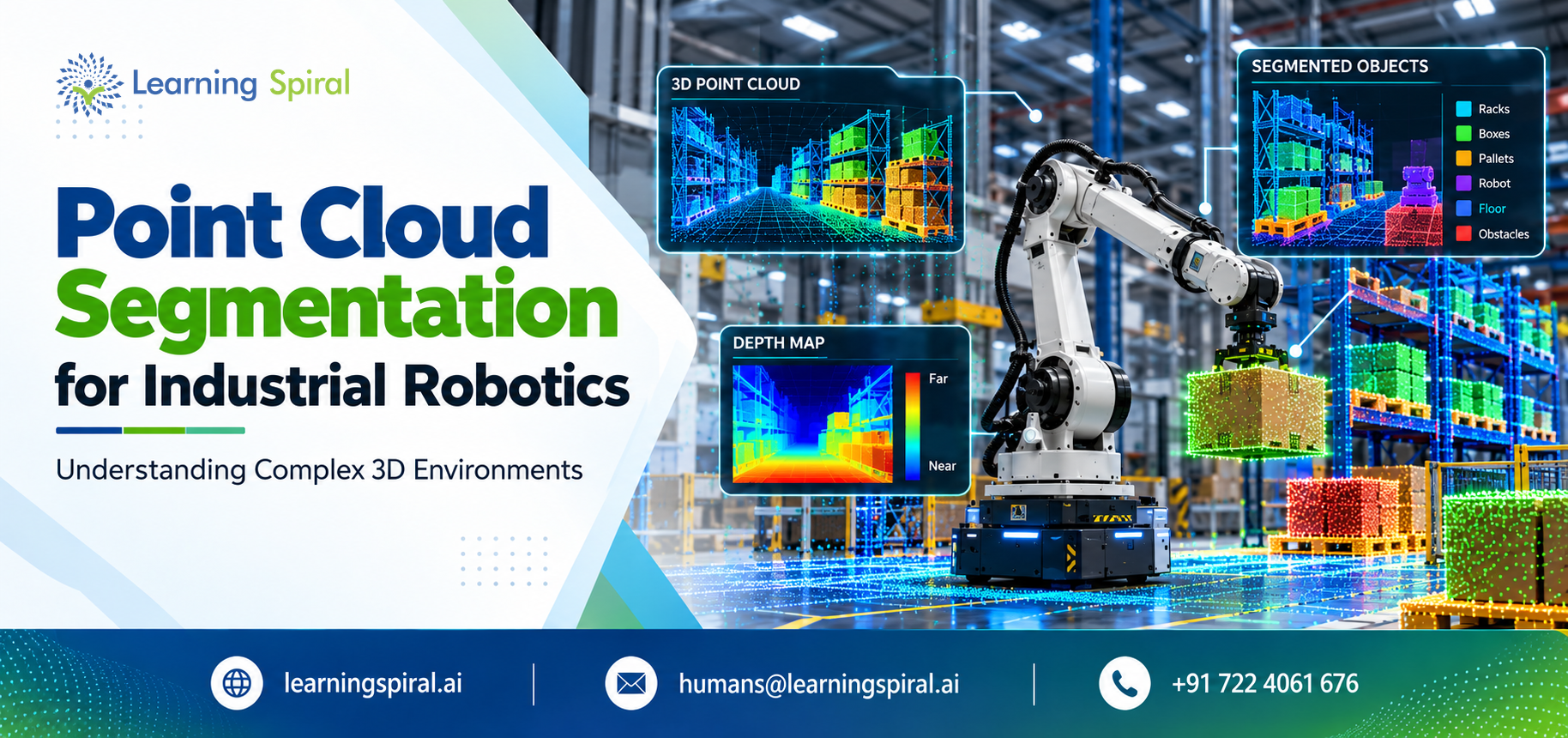
A robot arm on a factory floor does not “see” the way people do. It receives millions of tiny measurements of distance, and none of them mean anything until someone teaches the machine what each cluster of points represents. That teaching step is point cloud segmentation, and it is one of the most important building blocks of modern industrial robotics.
In this guide, we explain what point cloud segmentation is, why factories and warehouses depend on it, where projects usually go wrong, and how high-quality 3D point cloud annotation fixes those problems.
What Is Point Cloud Segmentation?
A point cloud is a set of data points in 3D space, usually captured by LiDAR, stereo cameras or depth sensors. Each point has x, y and z coordinates, and sometimes colour or intensity values.
Segmentation divides that cloud into meaningful groups. It is the 3D counterpart of image segmentation in 2D computer vision. There are four common types:
- Semantic segmentation: every point gets a class label such as floor, rack, pallet, human or machine.
- Instance segmentation: separates individual objects of the same class, for example Box 1 and Box 2.
- Part segmentation: splits one object into functional parts, such as the handle and body of a tool.
- Panoptic segmentation: combines semantic and instance labels in a single pass.
Why Industrial Robots Need It
Factories and warehouses are cluttered, reflective and constantly changing. Segmented 3D data lets robots handle that reliably:
- Bin picking: finding and grasping randomly placed parts.
- Autonomous mobile robots (AMRs): separating drivable floor from racks, people and forklifts.
- Palletizing and depalletizing: detecting box edges, stack height and gaps.
- Quality inspection: locating dents, weld seams and surface defects in 3D.
- Human-robot safety: identifying workers inside a robot’s working zone in real time.
Cameras alone struggle with lighting changes and depth. A well-segmented point cloud gives a robot true spatial awareness.
Challenges in Complex 3D Environments
Even strong models fail when the training data is weak. These are the usual problems:
- Sparse and uneven density: far objects return very few points.
- Occlusion: shelves, machines and people hide each other.
- Reflective and transparent surfaces: metal, shrink wrap and glass create noise and ghost points.
- Class imbalance: rare but critical objects such as a person or a fallen item appear far less often than floors and walls.
- Sensor fusion errors: misaligned camera and LiDAR data lead to wrong labels.
Better algorithms help, but the bigger lever is accurate, consistent labelled data.
How Annotation Powers Segmentation Models
Every segmentation model is only as good as the dataset it learns from. A reliable annotation workflow usually follows these steps:
- Define the taxonomy: clear class names, rules for edge cases and a shared labelling guide.
- Pre-label with AI assistance: automation handles repetitive work such as ground removal.
- Human-in-the-loop (HITL) correction: trained annotators fix boundaries, occlusions and ambiguous points.
- Multi-layer quality control: sampling, review and consensus checks keep labels consistent.
- Feedback loop: model errors flow back into the guidelines and the next batch.
To see how this looks in real projects, read our guides on 3D point cloud annotation for autonomous vehicles and systems and our LiDAR annotation guide for 3D labeling. The same principles carry over directly to factory and warehouse robots.
Why Precision Matters More in Robotics
In a self-driving car, one wrong label can cause a safety event. In a factory, one wrong label can mean a damaged part, a stopped line or an injured worker. Our article on how lidar annotation improves object detection explains why even small labelling errors carry heavy consequences, and the lesson applies fully to robotics.
Annotation Types Used Across AI Projects
Robotics rarely works with a single data type. Most production AI systems combine several, so teams often need one partner for:
- 3D point cloud and LiDAR annotation (cuboids, segmentation, tracking)
- Image annotation and image labeling with bounding box annotation, polygons and masks
- Video annotation for motion and action understanding
- Audio annotation and text annotation for voice commands and logs
- Medical data annotation for imaging and clinical AI
- Content moderation and sentiment analysis for language and vision models
Industries We Support
Image annotation for autonomous vehicles, logistics, retail, agriculture, aerial imagery, sports and games, healthcare and robotics all depend on the same rule: clean labels in, dependable models out.
Why Choose Learning Spiral AI?
Learning Spiral AI is a data annotation company and data labeling company based in India, delivering data labeling and annotation services for computer vision, NLP, audio and LiDAR projects. Our services include:
- Real-world and egocentric data collection for physical AI
- Robotics annotation and LiDAR and 3D annotation
- Image, video, text and audio annotation
- AI training data services and datasets for machine learning
- Human-in-the-loop quality control on every project
- Scalable teams for pilots and for long-running data annotation projects
If you are searching for computer vision companies in India, data labeling companies in India or reliable image annotation services, our team can set up a pilot that fits your timeline and accuracy needs.
Frequently Asked Questions
1. What is point cloud segmentation in robotics?
It is the process of labelling each point in a 3D scan so a robot can tell objects, surfaces and people apart.
2. How is point cloud annotation different from image annotation?
Image annotation works on flat pixels. Point cloud annotation works on volumetric x, y, z data, so annotators label in 3D views and need specialised tools.
3. Which sensors produce point clouds?
LiDAR, depth cameras, stereo vision rigs and structured-light scanners.
4. Why is human-in-the-loop important?
Automation is fast, but trained reviewers catch occlusions, edge cases and rare objects that models often miss.
5. Can Learning Spiral AI handle large annotation projects?
Yes. We support pilots as well as ongoing production volumes across image, video, audio, text and LiDAR data.
Conclusion
Point cloud segmentation gives industrial robots the 3D understanding they need to pick, move, inspect and work safely around people. Models matter, but accurate, consistent annotation is what makes them dependable in the real world.
