

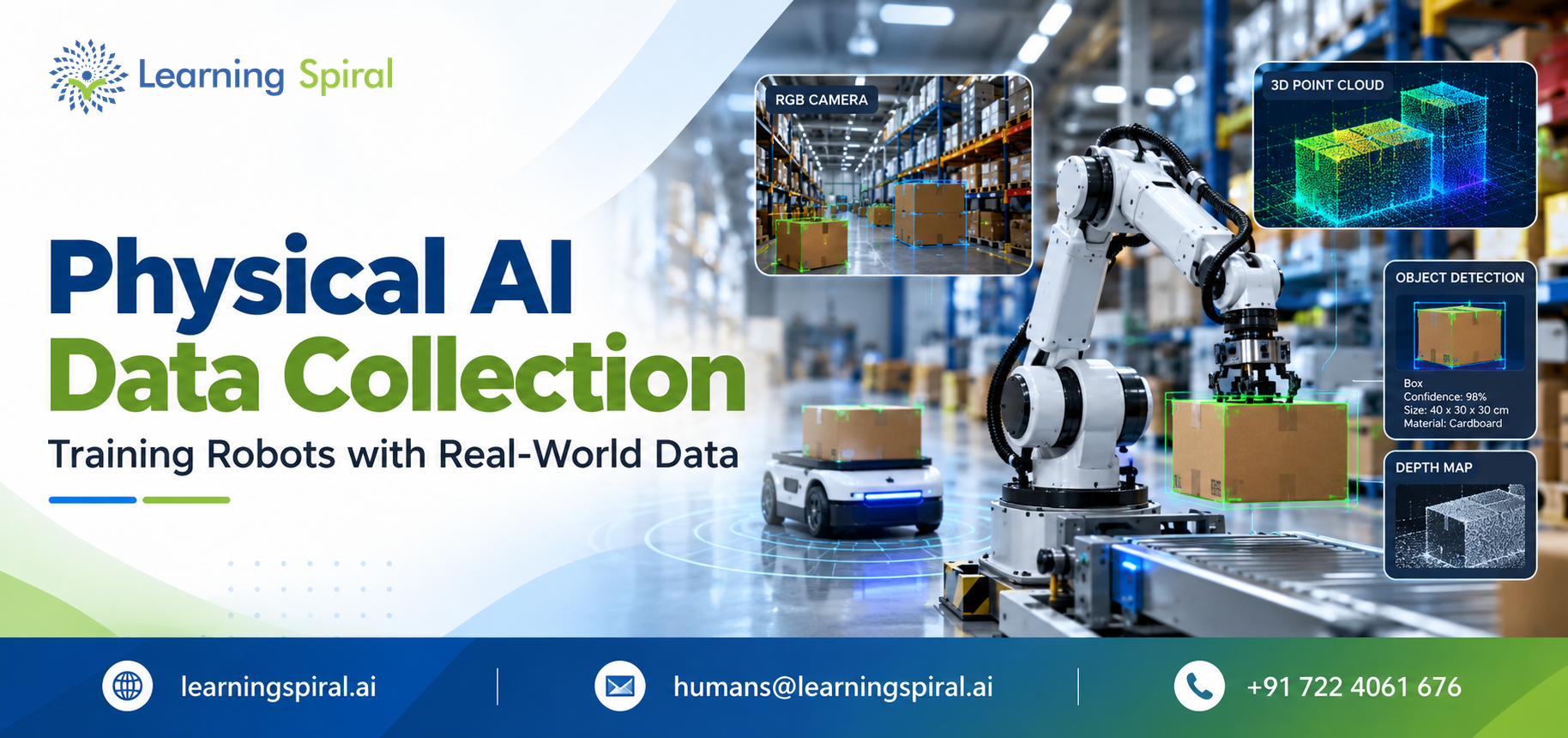
A robot can be built with the best hardware in the world, but without the right data it cannot pick up a cup, avoid a person or sort a parcel. Physical AI data collection is the process of capturing, organising and labeling real-world data so machines can perceive their surroundings and take the right action.
As warehouses, hospitals, farms and roads adopt intelligent machines, the demand for high-quality AI training data services is growing fast. In this blog we explain what physical AI is, why real-world datasets matter, and how expert annotation turns raw footage into robot intelligence.
What Is Physical AI?
Physical AI refers to artificial intelligence that lives inside machines which interact with the physical world: humanoid robots, robotic arms, drones, autonomous vehicles and smart industrial equipment. Unlike a chatbot, these systems must sense, decide and act in real time.
This is where robotics meets deep learning. The machine needs a deep understanding of objects, space, motion and human behavior, and all of that understanding comes from data.
Why Real-World Datasets Matter
Simulations help, but they cannot capture everything. Real environments are messy: lighting changes, objects overlap, floors are slippery, and humans behave unpredictably. Robots trained only on clean, synthetic data often fail when deployed.
Real-world datasets give robots:
- Context awareness: understanding where objects are and how they relate to each other.
- Robust performance: handling edge cases like glare, clutter, rain or motion blur.
- Safer human interaction: recognising gestures, posture and intent.
- Faster deployment: fewer failures after launch and less retraining.
Any serious dataset for machine learning in robotics must reflect the real environment where the robot will actually work.
Types of Data Used in Physical AI
1. Egocentric Data Collection
Egocentric data is captured from a first-person point of view, often through head-mounted or wearable cameras. It shows how a human performs a task such as folding clothes, assembling parts or cooking, and it is extremely valuable for teaching robots human-like manipulation. Egocentric data collection is one of the fastest-growing areas in robot learning.
2. Video and Image Data
Multi-angle video of warehouses, factories, kitchens and streets helps models understand objects and activities. Strong image annotation for robotics and video annotation make this footage usable for training.
3. LiDAR and 3D Point Cloud Data
Depth sensing helps robots and autonomous vehicles judge distance, shape and free space. Accurate LiDAR annotation and 3D point cloud labeling are essential for navigation and obstacle avoidance. Read more about the technology on Wikipedia’s Lidar page.
4. Audio and Text Data
Voice commands, ambient sounds and written instructions help robots follow human requests. Audio annotation and text annotation add the language layer to physical AI.
From Raw Data to Robot Intelligence: The Workflow
- Data planning: define the robot’s tasks, environment and success metrics.
- Data collection: capture diverse, real-world footage and sensor data across locations, lighting and scenarios.
- Data cleaning: remove duplicates, corrupted files and sensitive information.
- Annotation: label objects, actions, poses and depth using bounding boxes, polygons, keypoints and segmentation.
- Human in the Loop (HITL) quality checks: expert reviewers verify and correct labels to keep accuracy high.
- Model training and feedback: the labeled dataset trains the model, and errors guide the next round of data collection.
Quality annotation is what separates a working robot from a failed pilot. A professional data annotation company brings trained annotators, clear guidelines and multi-level quality control to every project.
Industries Using Physical AI Data
- Logistics and warehousing: parcel detection, pallet counting, pick-and-place training.
- Agriculture: crop, weed and fruit detection from aerial and ground robots.
- Retail: shelf monitoring, product recognition and inventory robots.
- Autonomous vehicles: lane, pedestrian and traffic object labeling.
- Healthcare: medical data annotation for surgical and assistive robotics.
- Sports and games: player tracking and motion analysis.
Many of these use cases rely on image annotation services that are customised for the specific sector.
Challenges in Physical AI Data Collection
- Diversity: collecting enough variety across environments and conditions.
- Annotation complexity: multi-sensor data needs synchronised labeling.
- Privacy and compliance: faces, locations and personal data must be protected.
- Consistency at scale: thousands of hours of footage need uniform labeling standards.
- Cost and time: in-house teams often lack the bandwidth for large projects.
This is why many AI companies and computer vision startups prefer to partner with a specialised data labeling company instead of building the pipeline from scratch.
How Learning Spiral AI Helps
Learning Spiral AI is a trusted partner for data labeling & annotation services, supporting AI teams across India and globally. Our services include:
- Image, video, audio and text annotation
- Bounding box, polygon and semantic segmentation
- LiDAR and 3D point cloud annotation
- Medical data annotation
- Egocentric and physical AI data collection
- Content moderation and sentiment analysis
- Human-in-the-loop quality assurance
Whether you are building a warehouse robot, a farming drone or an autonomous driving stack, our team delivers accurate, secure and scalable datasets. Ready to start? Contact Learning Spiral AI for a free consultation and a sample pilot.
Conclusion
Robots do not become intelligent by accident. They learn from carefully collected, expertly annotated real-world data. As physical AI grows, the quality of your AI training data will decide how safely and reliably your machines perform. Investing in the right data partner today is the fastest way to a robot that truly understands and acts.
FAQs
- What is physical AI data collection?
It is the process of gathering real-world sensor, video, audio and motion data so AI-powered machines can learn to perceive and interact with their environment. - Why is egocentric data important for robots?
First-person data shows exactly how humans perform tasks, helping robots learn natural manipulation and decision-making. - Which annotation types are used for robotics?
Bounding boxes, segmentation, keypoints, 3D cuboids, LiDAR point cloud labeling, and video and audio annotation. - How do I choose a data annotation company?
Look for domain experience, quality control with HITL, data security, scalability and transparent pricing. - Does Learning Spiral AI offer pilot projects?
Yes, you can reach out to discuss your requirements and start with a sample project.
