

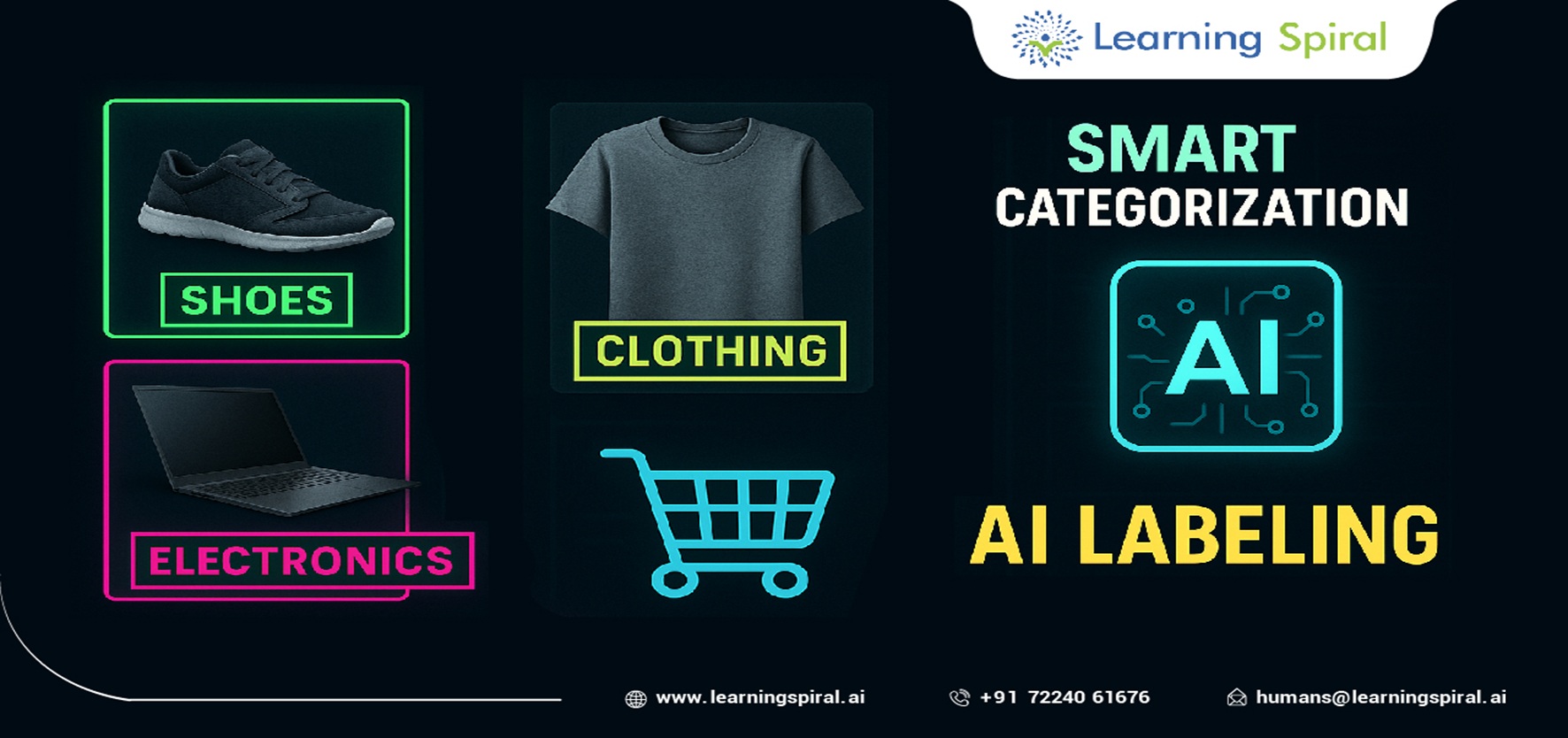
In today’s digital-first retail ecosystem, images have become the primary decision-making trigger for buyers. Shoppers rely more on visuals than text descriptions to evaluate products, compare options, and build trust. As a result, categorizing product images in retail and e-commerce is no longer a backend task—it’s a strategic capability.
Behind every visual search engine, recommendation system, or AI-powered catalog lies one critical component: high-quality labeled image data. Without accurate categorization, even the most advanced AI models fail to deliver relevance or scale.
At Learning Spiral AI, we’ve seen firsthand how structured image annotation directly impacts search accuracy, product discovery, and revenue growth across e-commerce platforms and AI-driven marketplaces.
What Is Product Image Categorization?
Product image categorization is the process of assigning structured labels to product images so machines can understand and organize them. These labels may include:
- Product type (e.g., shoes, handbags, smartphones)
- Attributes (color, material, size, pattern)
- Context (lifestyle vs. studio images)
- Hierarchical categories (category → subcategory → SKU)
This process enables computer vision models to interpret visual content in a way that aligns with business logic and customer intent.

Why Dataset Quality Is Critical for Retail AI
AI systems are only as good as the data they are trained on. According to industry research, poor-quality training data accounts for nearly 80% of AI project failures in production environments.
For e-commerce and retail, this translates into:
- Inaccurate visual search results
- Poor product recommendations
- Low personalization accuracy
- Increased customer drop-offs
High-quality image categorization ensures:
- Consistent product taxonomy
- Improved search relevance
- Faster model convergence
- Lower retraining costs
This is why enterprises increasingly partner with specialized data annotation services instead of relying on manual or automated shortcuts.
Common Use Cases of Product Image Categorization
1. AI-Powered Visual Search
Customers upload an image and instantly find visually similar products. Accurate categorization ensures the system understands product type, attributes, and context.
2. Smart Product Recommendations
AI models analyze categorized images to suggest complementary or similar products, boosting average order value.
3. Automated Catalog Management
Retailers with millions of SKUs use categorized images to auto-organize catalogs, reduce manual errors, and accelerate go-to-market.
4. Fraud & Listing Quality Control
Image categorization helps detect mismatched or misleading product listings, improving platform trust.
Core Image Annotation Techniques Used in E-commerce
Different AI tasks require different annotation approaches. The most commonly used techniques include:
- Bounding Box Annotation – Used to detect and localize products within images. Ideal for multi-object scenes and shelf images.
- Semantic Segmentation – Assigns a label to every pixel, enabling precise understanding of product shape and boundaries—essential for fashion and accessories.
- Attribute Tagging – Labels visual characteristics such as color, fabric, style, and pattern for advanced filtering and personalization.
- Hierarchical Classification – Organizes products across category levels to support structured catalogs and recommendation logic.
At Learning Spiral AI, we combine these techniques based on client use cases rather than applying a one-size-fits-all approach.
Step-by-Step Process for Categorizing Product Images
Step 1: Define Business Taxonomy
Align categories with how customers search and how inventory is structured.
Step 2: Annotation Guideline Design
Create detailed labeling rules to ensure consistency across annotators and datasets.
Step 3: Human-in-the-Loop Annotation
Domain-trained annotators label images while AI models assist with pre-labeling.
Step 4: Quality Control & Audits
Multi-layer QC ensures annotation accuracy above 98%.
Step 5: Dataset Validation
Final datasets are validated for balance, coverage, and bias before model training.
This structured workflow minimizes rework and maximizes long-term AI performance.
Why Manual or Fully Automated Labeling Falls Short
Many organizations attempt:
- Manual in-house tagging → slow, inconsistent, unscalable
- Fully automated labeling → fast but error-prone and biased
The optimal solution is human-in-the-loop data annotation, where AI accelerates labeling and humans ensure accuracy.
This hybrid approach:
- Reduces cost per image
- Improves consistency
- Enables rapid dataset scaling
Learning Spiral AI specializes in building such scalable annotation pipelines for enterprise AI teams.
How Learning Spiral AI Supports Retail & E-commerce AI
At Learning Spiral AI, we deliver end-to-end image annotation and training data solutions tailored for retail and e-commerce use cases.
Our strengths include:
- Domain-trained annotators for retail, fashion, and consumer goods
- Secure, compliant annotation workflows
- Scalable capacity for millions of images
- Custom taxonomy and attribute modeling
- Proven delivery across global AI and enterprise clients
“High-quality labeled data transformed our visual search accuracy and customer engagement. Learning Spiral AI delivered consistency at scale.”
— Enterprise Retail AI Lead (Client Testimonial)
👉 Contact Learning Spiral AI today for a free dataset audit and discover how expert product image categorization can unlock faster, smarter, and more scalable AI systems.