

What This Article Covers
- What egocentric data actually is
- Why robots need first-person vision to work in the real world
- How egocentric datasets are collected and annotated
- Egocentric vs. exocentric data — a side-by-side comparison
- Real-world applications across industries
- Key challenges in building egocentric datasets
- Best practices for annotation quality
- FAQs on egocentric data and robot vision
What Is Egocentric Data?
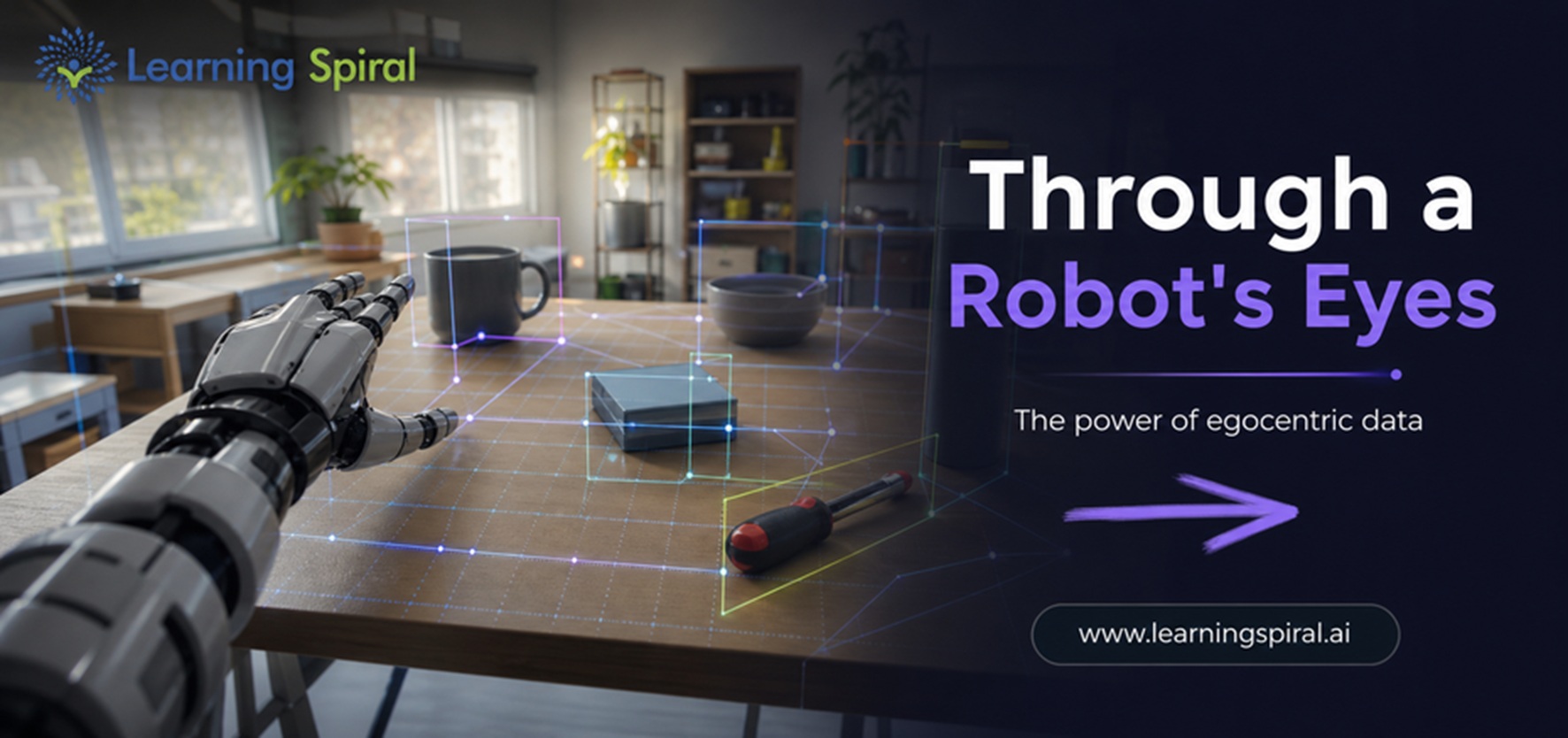
Egocentric data refers to visual, audio, or sensor information captured from a first-person point of view — typically through head-mounted cameras, smart glasses, or robot-mounted sensors — that shows a scene exactly as the person or machine performing an action would perceive it. Unlike traditional third-person footage, egocentric data captures hand movements, gaze direction, and object interaction from the actor’s own perspective, making it critical for training robots and wearable AI systems to understand human-like behavior.
Why Robots Need to “See” Like We Do
Most computer vision datasets used over the last decade were built from a third-person, or exocentric, vantage point — a fixed camera watching a scene from across the room. That works reasonably well for surveillance or sports analytics, but it breaks down the moment you want a robot to actually do something: pick up a cup, open a drawer, hand a tool to a person, or navigate a cluttered kitchen.
The problem is simple: <cite index=”0-1″>robots and other embodied agents need to be trained and evaluated on grounded data that faithfully reflects first-person, egocentric perspectives</cite>. When training data is captured from a fixed, external camera, the model never learns what an outstretched hand looks like from the actor’s own eyes, how objects occlude each other during manipulation, or how gaze shifts a split second before a grasp. That gap between how a model is trained and how it will actually operate is often called the “embodiment gap,” and it’s one of the biggest blockers to real-world robot deployment today.
This is why leading AI labs and robotics teams have accelerated investment in large-scale egocentric datasets over the past few years. <cite index=”0-2″>Datasets like Ego4D, spanning thousands of hours of daily-life footage captured by hundreds of camera wearers across multiple countries, and Ego-Exo4D, which pairs synchronized first-person and third-person views of the same skilled activities, have become foundational benchmarks for embodied AI research.</cite> The scale and diversity of this kind of data is what allows models to generalize instead of overfitting to a lab environment.
How Egocentric Datasets Are Built and Annotated
Collecting egocentric data is only step one — the real value comes from how precisely it’s labeled. A typical pipeline looks like this:
- Capture — Video, depth, audio, and often eye-gaze data are recorded simultaneously using head-mounted rigs, AR/VR headsets, or robot-mounted stereo cameras.
- Synchronization — Multiple sensor streams (RGB, depth, IMU, audio) are time-aligned to a single frame reference.
- Object and hand annotation — Bounding boxes, segmentation masks, and hand-pose keypoints are applied frame-by-frame to track what the actor is interacting with.
- Action segmentation — Continuous footage is broken into discrete action clips (e.g., “opens cabinet,” “picks up mug,” “pours liquid”) with start/end timestamps.
- Gaze and intent labeling — Where available, gaze vectors are annotated to help models learn attention and anticipated action.
- Quality review — A second layer of human reviewers validates label accuracy, consistency, and edge-case handling before the dataset is released for training.
This is where annotation expertise genuinely separates a usable dataset from a noisy one. Egocentric footage is inherently messy — fast head movement, motion blur, partial occlusion of hands and objects — and labeling it accurately requires annotators trained specifically for first-person, activity-centric data rather than generic image tagging. Organizations working with experienced AI data solution partners often achieve faster model accuracy and deployment because the annotation pipeline is built to handle exactly this kind of complexity from day one.
Egocentric vs. Exocentric Data: A Quick Comparison
| Factor | Egocentric (First-Person) Data | Exocentric (Third-Person) Data |
|---|---|---|
| Camera position | Worn/mounted on the actor (head, chest, robot arm) | Fixed, external viewpoint |
| Captures hand-object interaction | Yes, in high detail | Limited, often occluded |
| Reflects real deployment view | Closely matches robot/AR sensor viewpoint | Rarely matches on-device perspective |
| Gaze & attention data | Often included | Not applicable |
| Best suited for | Robotics, AR/VR, wearables, manipulation tasks | Surveillance, crowd analytics, sports tracking |
| Annotation complexity | High — motion blur, occlusion, fast viewpoint change | Moderate — stable frame, predictable geometry |
Where Egocentric Data Is Making a Real Difference
- Robotic manipulation — Training robotic arms and humanoids to grasp, pour, assemble, or hand off objects the way a human hand would approach them.
- AR/VR and smart glasses — Powering gesture recognition, object identification, and context-aware assistance in wearable devices.
- Autonomous vehicles — Driver-facing and cabin-facing egocentric feeds help train in-cabin monitoring and driver-assistance systems.
- Healthcare and surgical training — Surgeon point-of-view video is annotated to build skill-assessment and guidance models.
- Retail and logistics — First-person footage from warehouse workers or pickers helps train robots for pick-and-pack automation.
- Sports and coaching — Athlete point-of-view capture supports biomechanics analysis and performance modeling.
Key Challenges in Building Egocentric Datasets
Egocentric data is powerful, but it’s genuinely harder to work with than standard imagery, for a few reasons:
- Motion blur and instability — Head or robot movement introduces blur that standard annotation workflows aren’t built for.
- Frequent occlusion — Hands, tools, and objects constantly block each other in close-up manipulation scenes.
- Privacy sensitivity — First-person footage often captures bystanders, faces, and private environments, requiring careful anonymization and consent handling.
- Volume and diversity requirements — A model trained on one household or one warehouse won’t generalize; datasets need geographic, cultural, and task diversity at scale.
- Multi-modal alignment — Syncing video, depth, audio, and gaze data accurately is far more complex than labeling static images.
Best Practices for High-Quality Egocentric Annotation
- Use annotators trained specifically on first-person, activity-based labeling — not generalist image taggers.
- Apply multi-pass QA, especially for hand-pose and fine-grained object interaction labels.
- Standardize action taxonomies before annotation begins, so labels remain consistent across large teams.
- Build in privacy-first review steps (face blurring, consent flags) as part of the pipeline, not an afterthought.
- Validate against held-out human benchmarks periodically to catch annotation drift.
High-quality annotation is not just data — it’s the foundation of reliable AI systems. As embodied AI and humanoid robotics move from research labs into real homes and warehouses, the quality of the first-person data behind these models will directly determine how safely and reliably they perform. Learning Spiral AI works with teams building exactly this kind of complex, multi-modal training data, combining structured annotation workflows with domain-trained human reviewers to handle the nuance egocentric footage demands.
Frequently Asked Questions
1. What is egocentric data in AI and robotics? Egocentric data is visual or sensor information captured from a first-person point of view — such as through a head-mounted camera or robot-mounted sensor — showing a scene exactly as the actor performing the task would see it.
2. Why is egocentric data important for training robots? Because robots operate in the physical world from their own viewpoint, models trained only on third-person footage often fail to generalize to real deployment. Egocentric data closes this “embodiment gap” by matching training data to the robot’s actual operating perspective.
3. How is egocentric data different from regular video data? Regular (exocentric) video is captured from a fixed external camera, while egocentric data is captured from a moving, worn, or mounted viewpoint that closely mirrors hand movement, gaze, and object interaction — making it far more relevant for manipulation and interaction tasks.
4. What industries use egocentric data the most? Robotics, AR/VR and wearables, autonomous vehicles, healthcare/surgical training, retail and logistics automation, and sports performance analysis are among the top adopters of egocentric datasets.
5. What makes egocentric data annotation difficult? Motion blur, frequent hand-object occlusion, privacy concerns around bystanders and private spaces, and the need to synchronize multiple data streams (video, depth, audio, gaze) all make egocentric annotation significantly more complex than standard image labeling.
Explore Further
Interested in how large-scale, multi-modal training data gets built for robotics and embodied AI? Explore Learning Spiral AI’s data annotation services or connect with our team to talk through your model’s data needs. You can also learn more about our computer vision annotation capabilities on our services page.
