

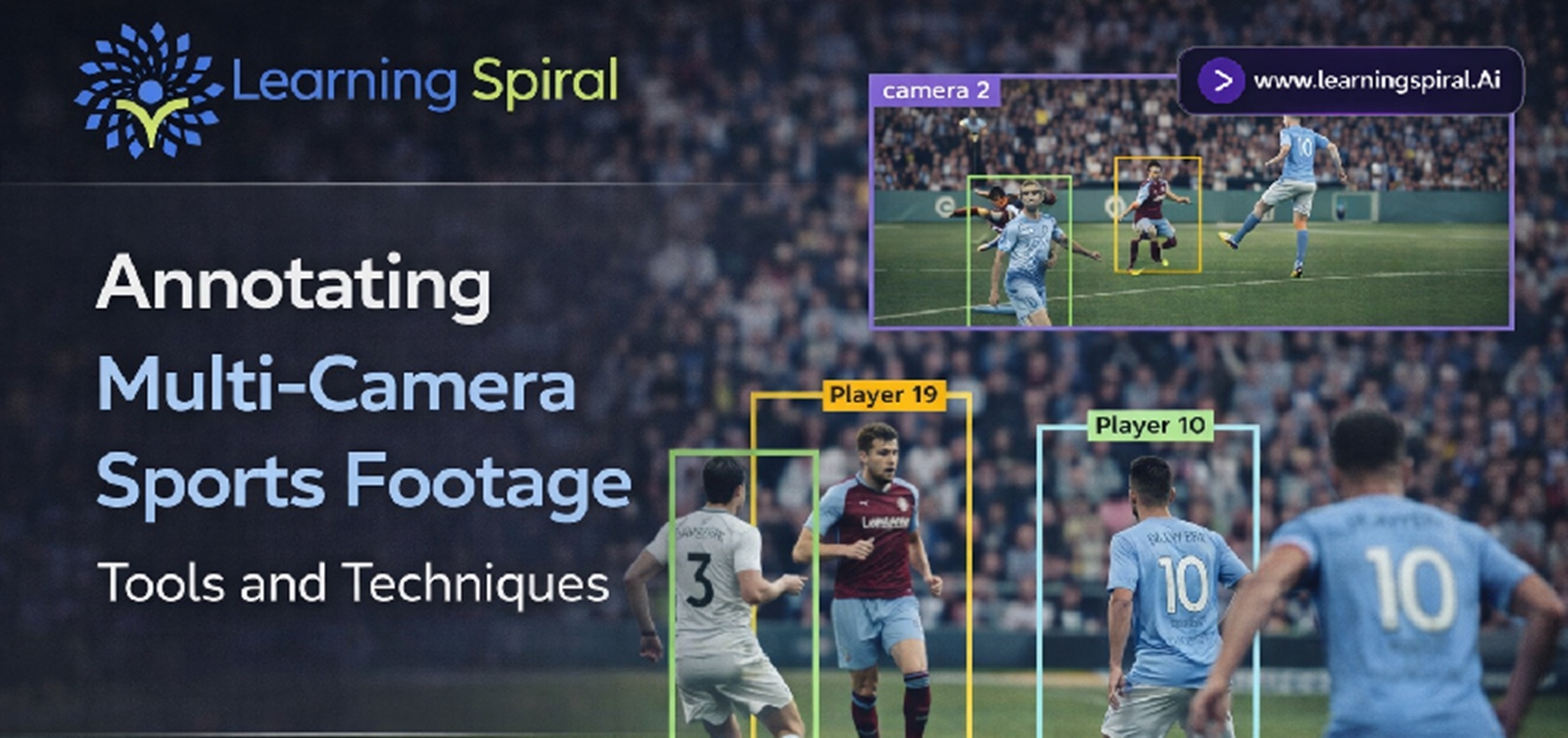
A striker enters the penalty area.
One camera follows the player. Another captures the goalkeeper. A third switches to a wide-angle view, while another records the same moment from behind the goal.
For viewers, these different perspectives make sports more exciting.
For an AI model, they create a much harder question:
How can the system understand that the player, ball and event seen across all those cameras belong to the same moment?
This is where multi-camera sports annotation becomes critical.
Modern sports AI applications increasingly depend on precisely labelled footage for player tracking, tactical analysis, automated highlights, pose estimation, officiating support and performance analytics. But simply collecting more video does not automatically create better AI.
The footage must first be transformed into structured, consistent and machine-readable training data.
Professional Video Annotation workflows help convert raw footage into labelled sequences that computer vision models can learn from. In multi-camera environments, that process becomes considerably more complex because identities, movements and events must remain consistent across different views.
Let us understand how it works.
Why Multi-Camera Sports Footage Is Difficult to Annotate
A conventional image annotation task deals with a single moment.
Sports video annotation deals with thousands of rapidly changing moments.
Multi-camera annotation adds another layer because the same event may appear differently depending on the camera.
An athlete may be:
- • fully visible in one view,
- • partially hidden in another,
- • extremely small in a wide shot,
- • temporarily outside another camera’s field of view,
- • or visually similar to multiple teammates.
The ball presents an even greater challenge because it can move quickly, become blurred, disappear behind players or leave one camera’s frame entirely.
For a Data Annotation Company, the goal therefore is not merely drawing labels frame by frame.
The real task is maintaining temporal, spatial and identity consistency across the complete sports sequence.
1. Start With Camera and Timeline Synchronization
Before annotation begins, every camera feed should be aligned to the same event timeline.
Imagine that Camera A captures a goal at frame 12,450 while Camera B records the same action several frames later because the cameras were started at different moments.
Without synchronization, annotators may incorrectly associate events across feeds.
A multi-camera workflow should therefore establish:
- • Camera ID
- • Video start time
- • Frame rate
- • Match or session ID
- • Timestamp alignment
- • Event timeline
- • Frame correspondence between cameras
This creates a common reference point for subsequent Data Labeling.
Without consistent synchronization, cross-camera player tracking and event annotation can quickly become unreliable.
2. Build a Clear Annotation Taxonomy Before Labeling
Sports footage contains far more than players.
Depending on the AI application, an annotation taxonomy may include:
- • Player
- • Goalkeeper
- • Referee
- • Ball
- • Goalpost
- • Court or field markings
- • Equipment
- • Team
- • Jersey number
- • Player identity
- • Possession
- • Pass
- • Shot
- • Tackle
- • Goal
- • Foul
- • Sprint
- • Jump
- • Collision
- • Substitution
The annotation team should define exactly what each class means before a large-scale project begins.
For example, should a partially visible athlete still receive a bounding box?
Should a ball hidden behind a player remain tracked as “occluded”?
When does a “pass” begin and end?
Clearly documented rules help a Data Labeling Company maintain consistency across annotators and across cameras.
3. Use Bounding Box Annotation for Player and Object Tracking
One of the most widely used techniques in sports datasets is Bounding Box Annotation.
A rectangular box is placed around objects such as:
- • players,
- • referees,
- • balls,
- • equipment,
- • vehicles in motorsports,
- • or other objects relevant to the game.
Each object can then receive a unique class or tracking ID.
For example:
Player_07 → Team_A → Camera_01
When that same player appears in Camera 02, the annotation workflow should preserve the correct identity whenever the project’s specifications require cross-camera identity tracking.
This is where sports data labeling & annotation services require careful human judgement.
Uniforms may look identical, athletes may overlap and camera angles may hide identifying features.
Learning Spiral AI’s sports-focused annotation capabilities also include bounding-box-based player and ball tracking for computer vision datasets.
4. Add Keypoint Annotation for Movement and Pose Analysis
A bounding box tells an AI model where a player is.
Keypoint annotation can help it understand how the player is moving.
Specific anatomical landmarks can be marked, such as:
- • shoulders
- • elbows
- • wrists
- • hips
- • knees
- • ankles
- • head position
This form of Image Annotation is especially useful for sports applications involving pose estimation, biomechanics, movement analysis and athletic performance.
For example, a model analysing a bowler, batsman, footballer or runner may need far more information than the person’s location.
It may need to understand:
Body orientation → Joint position → Motion sequence → Athletic action
Accurate keypoints provide that structural information.
5. Maintain Player Identity Across Cameras
Cross-camera identity consistency is one of the defining challenges of multi-camera sports annotation.
Consider a football player moving from the left side of the field toward the goal.
Camera A captures the run.
Camera B captures the player entering the penalty area.
Camera C records the final shot.
A useful dataset may need to recognise that all three views contain the same athlete.
This requires maintaining consistent IDs across camera feeds.
Annotators may use information such as:
- • Jersey number
- • Team colour
- • Player position
- • Body appearance
- • Timeline
- • Movement direction
- • Previous and subsequent frames
When visibility becomes uncertain, annotations should follow clearly defined occlusion and identity rules rather than guessing.
This is one area where Human in the Loop (HITL) remains highly valuable.
6. Handle Occlusion Without Breaking Tracks
Sports footage contains constant occlusion.
Players overlap. Referees cross the frame. Athletes move behind equipment. A ball disappears behind someone’s body.
Poor annotation may terminate an object track every time visibility is lost.
A better annotation workflow distinguishes between:
Visible → Partially Occluded → Fully Occluded → Visible Again
When sufficient evidence exists, the same tracking ID can continue after temporary occlusion.
This helps create more coherent training sequences for tracking models.
Human review is especially important in crowded sports because automated pre-annotation may confuse similar-looking players or switch identities after an overlap.
7. Annotate the Ball With Greater Precision
In many sports datasets, the ball is one of the hardest objects to label.
Why?
Because it may be:
- • extremely small,
- • moving rapidly,
- • affected by motion blur,
- • partially hidden,
- • visually similar to the background,
- • visible in one camera but missing in another.
A reliable Image Annotation Company must therefore establish specific ball-labeling rules.
Annotators may need to inspect adjacent frames to understand the ball’s trajectory rather than judging a single frame independently.
This temporal context makes Video Annotation fundamentally different from isolated image labeling.
8. Label Actions and Events, Not Just Objects
Knowing where players are is valuable.
Knowing what they are doing is often even more valuable.
Sports AI datasets may require temporal event labels such as:
- Pass
- Shot
- Goal
- Tackle
- Serve
- Sprint
- Jump
- Catch
- Foul
- Celebration
Each event can be associated with a start timestamp, end timestamp, athlete ID and potentially multiple camera views.
This type of annotation supports applications such as automated highlights, action recognition and game-event detection.
Learning Spiral AI also describes video annotation workflows for automated sports highlights and action tracking.
9. Combine Bounding Boxes, Keypoints and Event Tags
The most useful sports datasets frequently use several annotation types together.
Consider a basketball shot.
The dataset might contain:
Bounding Box → Player location
Tracking ID → Athlete identity
Keypoints → Body movement
Ball annotation → Ball trajectory
Temporal label → Shot attempt
Camera ID → Source viewpoint
The combination gives the model richer context than any single annotation method.
This is why complex Data annotation projects require carefully designed schemas rather than simply increasing annotation volume.
10. Use Human in the Loop for Difficult Sports Sequences
Automation can accelerate annotation.
It should not automatically be trusted as the final answer.
Sports footage contains difficult edge cases:
- • heavy player overlap,
- • sudden camera cuts,
- • motion blur,
- • fast ball movement,
- • similar uniforms,
- • partial visibility,
- • replay sequences,
- • spectators entering the frame,
- • lighting changes.
A Human in the Loop (HITL) workflow can use machine-assisted predictions as a starting point while trained annotators validate or correct them.
The process may look like:
Model prediction → Human verification → Correction → Quality review → Final Dataset
This approach can support scalable AI Training Data Services while retaining human judgement where ambiguity is high.
11. Apply Interpolation Carefully
Manually drawing the same bounding box across every frame can be inefficient.
Annotation tools may therefore use interpolation.
An annotator labels an object at selected keyframes, and the tool estimates its position across intermediate frames.
For example:
Frame 100 → Manually labelled
Frames 101–109 → Interpolated
Frame 110 → Manually labelled
This can reduce repetitive work when movement is predictable.
However, interpolation should be reviewed around:
- • sudden direction changes,
- • collisions,
- • occlusion,
- • camera movement,
- • zoom,
- • scene cuts.
Human validation prevents small interpolation errors from propagating across hundreds of frames.
12. Separate Live Play, Replays and Camera Cuts
Broadcast sports footage introduces another complication.
The same event may appear multiple times.
A goal might occur once but then be replayed from three different angles.
If replay footage is treated as another live event, the dataset may contain duplicate or misleading event labels.
Annotation specifications should therefore identify:
- • Live play
- • Replay
- • Slow motion
- • Camera cut
- • Crowd shot
- • Graphic overlay
- • Advertisement or interruption
This creates cleaner datasets for event-recognition models.
13. Quality Control Is Critical in Multi-Camera Annotation
Sports datasets can contain hundreds of thousands or millions of frames.
A small labeling inconsistency can therefore multiply quickly.
Quality assurance should check more than whether a box exists.
Reviewers should verify:
- • Class accuracy
- • Bounding box placement
- • Player identity
- • Cross-camera consistency
- • Keypoint placement
- • Occlusion status
- • Event timestamps
- • Track continuity
- • Missing objects
- • Duplicate annotations
A structured quality workflow may involve:
Level 1: Annotator self-check
Level 2: Dedicated QC review
Level 3: Cross-camera consistency validation
Level 4: Edge-case escalation
That is particularly important when building a Dataset for Machine Learning that will ultimately influence model behaviour.
14. The Role of Computer Vision in Sports Analytics
Sports technology increasingly uses computer vision to transform visual footage into structured information.
Applications can include:
- • Player tracking
- • Ball tracking
- • Pose estimation
- • Tactical analysis
- • Automated highlights
- • Performance analytics
- • Action recognition
- • Referee assistance
- • Training analysis
- • Fan-engagement applications
Teams developing these systems often depend on experienced Computer Vision Companies in India and specialist annotation providers to prepare the visual data needed for model development.
At its core, Computer Vision Companies in India work with systems designed to extract useful information from visual inputs such as images and videos.
Accurate annotation provides the supervised ground truth that helps such models learn what those visual signals mean.
15. What to Look for in a Sports Data Annotation Partner
Choosing a Data Annotation Company should involve more than comparing annotation cost per frame.
For multi-camera sports datasets, evaluate whether the provider can manage:
- Multi-camera synchronization
The workflow should maintain reliable relationships between different camera streams. - Identity consistency
Player IDs and object tracks must remain consistent wherever the project requires them. - Multiple annotation techniques
Projects may require bounding boxes, keypoints, image labeling, tracking and event tagging together. - Human review
Complex sequences benefit from trained human validation. - Quality assurance
QC should examine temporal and cross-camera consistency—not only individual frames. - Scalability
Large Annotation projects can contain millions of frames and require structured workforce management. - Data security
Raw footage, proprietary match data and athlete information may require controlled access. - Domain understanding
Sports-specific events and movement patterns need clearly defined annotation guidelines.
How Learning Spiral AI Supports Sports Data Annotation
Learning Spiral AI provides scalable human-reviewed Data Annotation and Data Labeling capabilities for computer vision and AI projects. Its published services include image annotation, video and motion tracking, keypoint labeling and broader data-labeling workflows.
For sports-focused applications, annotation workflows can support areas such as:
- • Image annotation for sports and games
- • Video Annotation
- • Player and ball tracking
- • Bounding Box Annotation
- • Keypoint and pose annotation
- • Action recognition
- • Event tagging
- • Frame-by-frame validation
- • Data Labeling Services
- • AI Training Data Services
- • Human in the Loop (HITL) quality workflows
Learning Spiral AI’s broader capabilities also span image, video, text, audio and 3D-oriented annotation projects, allowing organizations working across different AI modalities to build structured training datasets.
From Multiple Cameras to One AI-Ready Understanding of the Game
Multi-camera sports footage gives AI more information—but only when those perspectives are connected correctly.
A model needs to understand that:
Player 17 in Camera A is still Player 17 in Camera B.
The ball disappearing behind a defender has not ceased to exist.
A replay of a goal is not a second goal.
A running athlete is more than a bounding box—the movement itself may matter.
That understanding begins with accurate annotation.
Through synchronized video streams, consistent tracking IDs, bounding boxes, keypoints, event labels and Human in the Loop validation, raw sports footage can be transformed into structured data capable of supporting sophisticated computer vision models.
For AI teams building sports analytics, automated highlights, athlete tracking or action-recognition systems, annotation quality is therefore not simply a preprocessing task.
It is the foundation on which the intelligence of the model is built.
Sports AI With Better Training Data
Building a sports analytics, player-tracking, action-recognition or computer vision solution?
Learning Spiral AI provides scalable, human-reviewed data annotation and labeling services to help transform complex sports footage into accurate, structured and AI-ready datasets.
