

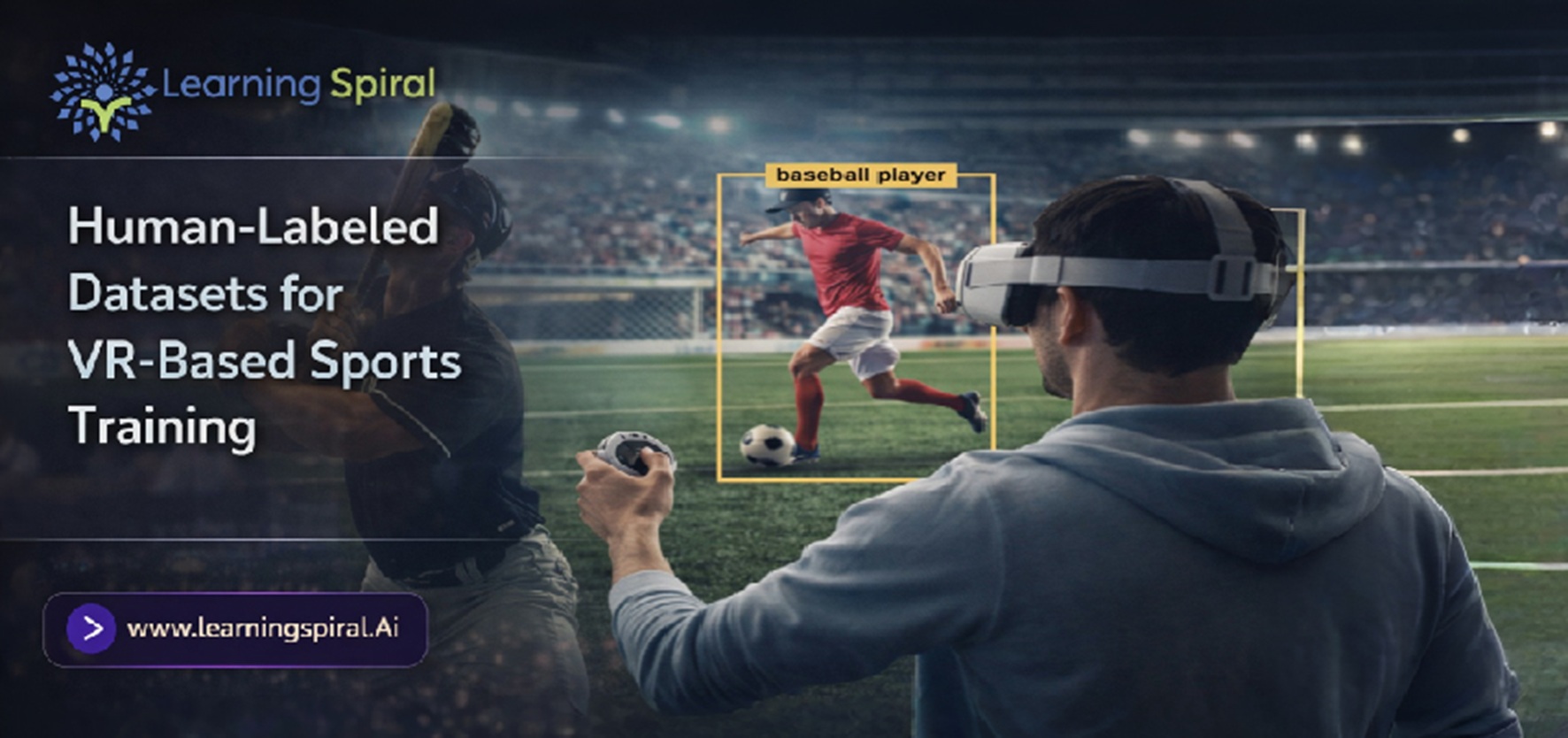
Put on a VR headset and a player can practise a penalty kick, face a virtual fast bowler, rehearse a defensive movement or repeat a complex training drill without entering a real stadium.
But creating the virtual environment is only half the challenge.
For a VR sports training system to become intelligent, it needs to understand what the athlete is actually doing.
Was the player’s knee correctly positioned?
Did the bat follow the intended trajectory?
Was the athlete late in reacting?
Was body balance maintained?
Did the player move into the correct position?
Answering questions like these requires more than raw video.
It requires human-labeled training data.
This is where data annotation becomes a critical part of AI-powered sports training. By labeling players, body joints, equipment, actions, objects and movement sequences, annotation teams turn raw visual information into structured datasets that computer vision systems can learn from.
For developers building VR coaching platforms, sports analytics tools and immersive athlete-training applications, a reliable Dataset for Machine Learning can become the foundation on which the entire AI experience is built.
Why VR Sports Training Needs More Than Realistic Graphics
A visually impressive virtual training environment may feel realistic, but visual realism alone does not make it intelligent.
An AI-powered training environment should ideally understand:
- • Where the athlete is positioned
- • How the body is moving
- • Which action is being performed
- • How equipment is being handled
- • Whether the movement matches the intended technique
- • How the athlete reacts to changing situations
- • What happens before, during and after a particular movement
This is where computer vision and high-quality data labeling become important.
Data labeling gives training examples meaningful labels so machine learning systems can learn patterns from them.
In sports, those labels may represent a player’s joints, a football, cricket bat, racket, goalpost, movement sequence, posture, speed phase or interaction with another athlete.
The richer and more consistent those labels are, the more useful the dataset becomes for training sports AI.
1. Human-Labeled Data Helps AI Understand Athlete Movement
Movement is at the centre of almost every sport.
A human observer can instantly distinguish between running, jumping, throwing, swinging, tackling or changing direction.
An AI model has to learn those distinctions.
Through Image Annotation Services, individual frames can be labeled to identify athletes, sports equipment, body landmarks and other important visual elements.
For movement-heavy applications, keypoint annotation can mark important joints such as:
- • Head
- • Shoulders
- • Elbows
- • Wrists
- • Hips
- • Knees
- • Ankles
When these points are consistently labeled across large datasets, computer vision systems can learn patterns associated with posture and motion.
This is particularly useful for Image annotation for sports and games, where small changes in body positioning can have a significant impact on how an action is interpreted.
2. Video Annotation Adds the Dimension VR Training Really Needs: Time
A single image can tell an AI model where a player is.
A sequence of frames can tell it how that player moved.
That is why Video Annotation becomes especially important for VR-based sports applications.
Video annotation can label an activity throughout its complete sequence instead of treating every frame as an isolated picture.
Consider a cricket batting action.
A training sequence may include:
1. Initial stance →
2. Backlift →
3. Foot movement →
4. Bat acceleration →
5. Ball contact →
6. Follow-through
If these stages are labeled consistently across thousands of examples, an AI model can begin learning the temporal patterns that distinguish one movement from another.
The same concept can apply to football kicks, tennis serves, golf swings, basketball shots, athletic starts or rehabilitation exercises.
Learning Spiral AI’s current Video Annotation offering includes object tracking, action labeling, event detection and temporal data tagging—capabilities directly relevant to movement-based computer vision workflows.
3. Bounding Box Annotation Helps Track Players and Equipment
Before an AI system can evaluate movement, it often needs to identify what is moving.
Bounding Box Annotation places labeled rectangular regions around objects in video frames or images.
In a sports environment, boxes might identify:
- • Individual players
- • Ball
- • Bat
- • Racket
- • Goalkeeper
- • Training equipment
- • Protective gear
- • Relevant objects within the training area
Bounding boxes are especially useful for object detection and tracking.
For instance, a VR football-training application could use labeled footage to help an AI model differentiate between the athlete, ball and goal while tracking their relative movement.
Similarly, basketball training models can learn to follow players and the ball across sequences.
4. Keypoint Annotation Can Turn Body Movement Into Structured Data
For detailed technique analysis, simply detecting the athlete may not be enough.
The system needs to understand the pose.
Keypoint annotation converts the athlete’s body into identifiable landmarks.
Imagine analysing a tennis serve.
Instead of telling the model only that a tennis player is present, annotated keypoints can help represent:
Shoulder position → Elbow angle → Wrist movement → Hip rotation → Knee bend → Follow-through posture
This creates a much richer representation of the movement.
It can support applications involving:
- • Pose estimation
- • Movement analysis
- • Technique comparison
- • Exercise recognition
- • Sports analytics
- • Virtual coaching
- • Gesture recognition
Learning Spiral AI’s sports offering specifically includes player tracking and pose/action-detection use cases, while its image-annotation services include keypoint labeling for sports analytics and movement tracking.
5. Egocentric Data Collection Can Capture Sport From the Athlete’s Perspective
Not every useful sports dataset needs to come from a camera placed outside the playing field.
Egocentric Data Collection captures the environment from the athlete’s or participant’s point of view.
Imagine a camera mounted on a player during training.
The resulting footage can show:
- • What the athlete sees
- • Which objects enter their field of view
- • How quickly they react
- • How hands interact with equipment
- • How attention shifts throughout an activity
- • How the environment changes during motion
This perspective can be highly valuable when designing immersive training scenarios.
For example, first-person data could help developers model situations in which an athlete needs to identify an incoming opponent, react to an object or make a rapid positional decision.
Egocentric datasets also create interesting opportunities beyond sports, including robotics and Image Annotation for Robotics, because both domains involve understanding actions from an agent-entranced perspective.
6. Physical AI Data Collection Connects Digital Training With Real Movement
VR sports applications increasingly interact with the physical world through cameras, motion sensors, controllers and wearable devices.
That makes Physical AI Data Collection another important component.
Instead of training AI only on static datasets, developers can collect data from real human actions performed under different physical conditions.
A good dataset may deliberately include variations in:
- • Athlete height
- • Body posture
- • Camera angle
- • Lighting
- • Clothing
- • Equipment
- • Background
- • Speed
- • Skill level
- • Playing environment
Why does this matter?
Because AI needs diversity to learn how the same action can appear under different real-world conditions.
A model trained only on perfectly controlled footage may struggle when used in a real training environment.
7. Human in the Loop Keeps Sports Data Contextually Accurate
Automation can accelerate annotation.
But sports movements frequently contain nuances that automated tools may misinterpret.
Was the player’s foot actually in contact with the ground?
Was that movement a pass or an attempted shot?
Did an action start at frame 315 or frame 318?
Did the player intentionally change direction?
These decisions can require human judgement.
A Human in the Loop (HITL) workflow combines automation with human review so difficult or ambiguous examples can be checked by people.
A typical HITL annotation workflow may involve:
1. Data collection
Raw images, video or sensor information is collected.
2. Initial annotation
Annotators label people, objects, actions, events and movements.
3. Quality review
Annotations are checked against predefined guidelines.
4. Model-assisted labeling
Existing models may pre-label straightforward examples.
5. Human correction
Annotators review incorrect or uncertain predictions.
6. Dataset refinement
Corrected samples can be fed into future training cycles.
This feedback loop can help AI teams improve dataset consistency while scaling larger Data annotation projects.
8. 3D Data Can Make Spatial Sports Training More Intelligent
Sports do not happen in two dimensions.
An athlete moves through physical space.
That means advanced VR and spatial-training applications may also benefit from depth and 3D information.
3D point cloud annotation and Lidar Annotation can classify objects and spatial regions inside three-dimensional datasets.
Depending on the application, this can help represent:
- • Training spaces
- • Courts
- • Fields
- • Equipment
- • Obstacles
- • Player positions
- • Spatial relationships
This kind of spatial intelligence can become relevant when developers need a more detailed digital representation of physical training environments.
9. Multimodal Annotation Can Make Training Experiences Richer
Sports training is rarely visual only.
A coach may speak instructions.
A player may respond.
A system may generate written performance feedback.
Sensors may capture motion.
Video captures action.
This creates an opportunity for multimodal AI Data Solutions.
Different annotation types can work together:
• Image Annotation: Identifies players, equipment, body landmarks and scenes.
• Video Annotation: Tracks actions, movement and time-dependent events.
• Audio Annotation: Labels spoken instructions, commands and acoustic events.
• Text Annotation: Structures coaching notes, performance feedback and instructions.
• Image Labeling: Categorises frames, techniques, movements or events.
Combining multiple data formats can help AI systems develop a richer understanding of a training session rather than processing each source in isolation.
10. What Makes a High-Quality Dataset for VR Sports Training?
More data does not automatically mean better AI.
Better-labeled data matters more.
A high-quality sports training dataset should focus on several characteristics.
1. Annotation accuracy
Body landmarks, equipment and actions must be labeled consistently.
2. Temporal consistency
Objects should maintain consistent identities across video frames.
3. Diverse athletes
Training data should contain meaningful variation rather than one repetitive scenario.
4. Multiple camera perspectives
Different viewing angles help models generalise better.
5. Clear annotation guidelines
Annotators need precise definitions for every class and action.
6. Quality assurance
Annotations should be reviewed before they become training data.
7. Real-world complexity
Datasets should represent the environments in which the model will eventually operate.
This is where experienced Data labeling & annotation services become valuable.
11. Why Human-Labeled Datasets Matter for VR Coaching
The goal of VR-based training is not simply to recreate a sporting environment.
The bigger opportunity is to build a training system that can observe, understand and respond.
Imagine a virtual coach capable of recognising that:
Your shoulder rotated too early.
Or:
Your weight shifted to the wrong leg during the movement.
Or:
Your reaction began later than expected.
For such feedback to become useful, the underlying computer vision model first needs examples of correctly identified movements.
Human-labeled datasets provide that ground truth.
They teach AI what it should recognise before asking it to analysis new athletes.
12. Applications Across Different Sports
The same annotation principles can support very different sports.
Football
Player and ball tracking, positional movement, kick analysis, tactical movement and reaction analysis.
Cricket
Batting posture, bowling action, player positioning, ball tracking and movement analysis.
Tennis
Serve mechanics, racket movement, player position and body-pose analysis.
Basketball
Player tracking, shot sequences, ball movement and defensive positioning.
Athletics
Running posture, stride phases, start position, acceleration and joint movement.
Fitness & Training
Exercise recognition, repetition counting, posture analysis and movement correction.
This is why Image annotation for sports and games Image annotation for sports and games is becoming increasingly relevant to organisations developing computer vision-powered coaching and sports intelligence.
13. Choosing the Right Data Annotation Company for Sports AI
A sports AI team should evaluate more than how quickly an annotation vendor can label frames.
The important questions are:
• Can the Data Annotation Company maintain temporal consistency?
• Can its annotators follow complex movement taxonomies?
• Can it support Image Annotation, Video Annotation and Bounding Box Annotation together?
• Does it offer Human in the Loop workflows?
• Can it scale large Annotation projects without sacrificing QA?
• Can it support custom Dataset for Machine Learning requirements?
• Can it work with data-security requirements?
For companies evaluating Computer Vision Companies in India, Data Labeling Companies in India or Image Annotation Companies in India, project quality should ultimately be judged by how reliably the labeled data supports the intended AI model.
How Learning Spiral AI Supports Sports & Computer Vision Data
Learning Spiral AI provides AI Training Data Services and scalable Data Annotation Services for computer vision and machine learning applications.
Our annotation capabilities include:
- • Image Annotation
- • Video Annotation
- • Bounding Box Annotation
- • Keypoint Labeling
- • Image Labeling
- • Data Labeling
- • Human in the Loop (HITL)
- • 3D Point Cloud Annotation
- • Lidar Annotation
- • Audio Annotation
- • Text Annotation
- • Egocentric Data Collection
- • Physical AI Data Collection
For sports-focused AI, these capabilities can support player tracking, pose estimation, action recognition, movement analysis and other computer-vision workflows.
Beyond sports, similar data annotation services can support AI applications involving autonomous vehicles, robotics, aerial imagery, agriculture, retail, logistics, medical data annotation, content moderation, LLM workflows and other enterprise AI use cases.
Learning Spiral AI describes its current offering as human-in-the-loop annotation and data-labeling services for scalable AI model development.
From Raw Movement to Machine Intelligence
Every intelligent VR sports experience begins with something very human:
someone teaching the machine what the movement means.
A camera captures motion.
Human annotators add context.
The dataset teaches the model.
The model learns patterns.
And eventually, the VR system can transform those patterns into useful training intelligence.
That is the real value of human-labeled datasets.
They create the bridge between physical athletic performance and digital machine understanding.
For teams building the next generation of virtual coaching, sports analytics and immersive training platforms, that bridge may be one of the most important parts of the entire AI pipeline.
Ready to Build Better Training Data for Sports AI?
Looking for a reliable Data Labeling Company, Image Annotation Company or annotation partner for your computer vision project?
Learning Spiral AI can help you create accurately labeled, scalable and project-specific training datasets.
