

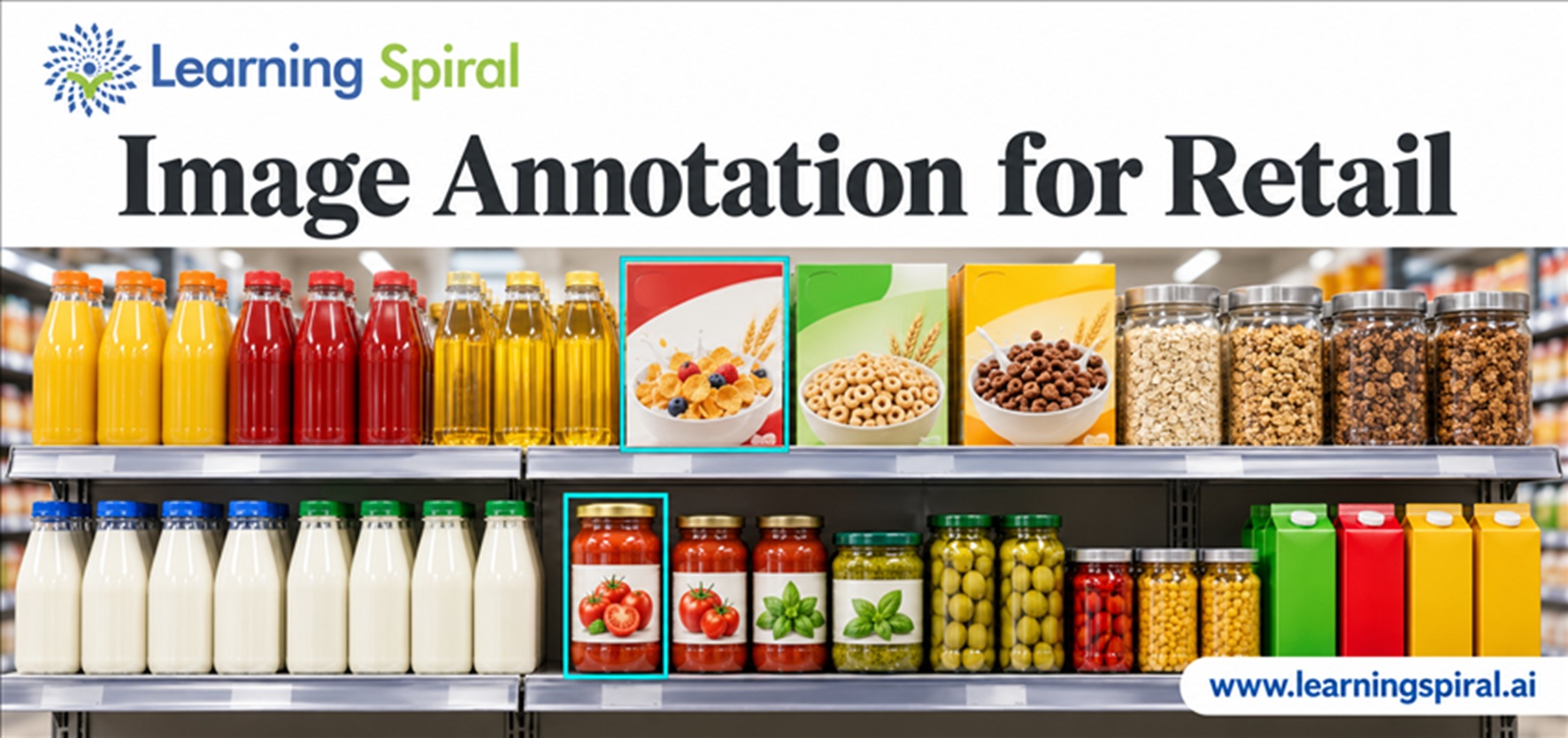
Imagine walking into a supermarket where every shelf is monitored intelligently, misplaced products are identified automatically, and inventory teams know exactly which items need attention. This is the potential of artificial intelligence in modern retail.
From grocery chains and supermarkets to fashion stores and e-commerce warehouses, retailers are exploring smarter ways to track products, improve shelf visibility, and reduce operational inefficiencies. Behind many of these innovations lies a crucial technology: Image Annotation for Retail.
By transforming ordinary store images into structured, labeled datasets, image annotation helps AI systems recognize products, locate shelf gaps, identify misplaced merchandise, and support inventory decisions.
For businesses developing retail automation technologies, professional data annotation services provide the foundation for training reliable computer vision models.
What Is Image Annotation for Retail?
Image Annotation for Retail is the process of labeling products, shelves, packaging, price tags, promotional displays, and other visual elements within retail images so artificial intelligence systems can understand them.
Consider a photograph of a supermarket shelf containing hundreds of products. A person can usually distinguish between different brands, packaging sizes, and product categories. However, an AI system must learn these distinctions through appropriate training examples.
This is where image labeling becomes essential.
Annotators identify individual products, assign category labels, mark product boundaries, and sometimes capture additional attributes such as brand, visibility, orientation, and shelf position.
These annotations form a structured Dataset for Machine Learning, enabling AI models to identify objects and learn visual patterns.
The underlying technology belongs to the broader field of Computer Vision, which enables machines to extract meaningful information from digital images and videos.
When supported by accurate training data, computer vision can help retailers transform large collections of store images into actionable merchandising and inventory insights.
Why Retail Businesses Need High-Quality Image Annotation
Retail environments are visually complex. A single aisle may contain thousands of similar-looking products with different packaging, labels, colors, and sizes.
Even experienced AI models can struggle when products are partially hidden, shelves are crowded, lighting is inconsistent, or packaging changes.
Without high-quality data labeling, computer vision systems may confuse similar products, overlook empty shelf spaces, or misidentify merchandise.
Professional Image Annotation Services help prepare consistent labeled datasets for these challenging environments.
Accurate annotations can support better product identification, more dependable shelf analysis, and improved model evaluation. They also help development teams discover the visual situations their models do not yet handle effectively.
For retailers, the potential business benefits include faster shelf audits, better product availability monitoring, stronger merchandising compliance, and more informed replenishment decisions.
Importantly, annotation quality alone does not guarantee model performance. Camera placement, model architecture, dataset diversity, and ongoing validation also influence results.
How Image Annotation Powers Retail Product Recognition AI
Product recognition is one of the most important applications of image annotation in retail.
AI-powered product recognition systems analyze images and attempt to identify specific products or categories, including packaged foods, beverages, cosmetics, electronics, and apparel.
To train these systems, Image Annotation specialists label examples of products from different angles, lighting conditions, and shelf arrangements.
For example, a retail image dataset may contain multiple brands of bottled water with almost identical shapes. Annotators distinguish them using visible packaging details, labels, cap colors, and other relevant features.
These labeled examples teach the AI model to recognize visual differences rather than treating every bottle as the same product.
Product detection using bounding box annotation
One widely used technique is bounding box annotation, which involves drawing rectangular boundaries around individual objects.
In retail environments, bounding boxes can identify product packages, display units, shelf labels, and shopping baskets.
Bounding boxes also support object detection approaches such as You Only Look Once (YOLO), a family of computer vision models designed to locate and classify objects in images.
However, detecting a product and recognizing its exact SKU are different challenges. Fine-grained SKU identification may require additional product attributes, close-up imagery, and specialized classification models.
Segmentation for crowded retail shelves
When products overlap or have irregular shapes, pixel-level segmentation can provide more precise object boundaries.
Instead of marking a rectangular area, annotators identify the actual visible regions belonging to a product.
This can be particularly valuable for crowded shelves, loose merchandise, complex packaging, and densely arranged displays.
Selecting the right annotation technique depends on the intended AI application, dataset complexity, and required level of precision.
AI-Powered Shelf Monitoring: Making Retail Shelves Smarter
Empty shelves can create missed selling opportunities even when products remain available elsewhere in a store.
Traditional shelf audits require employees to inspect displays manually, record missing products, and check whether items are positioned correctly.
AI-powered shelf monitoring offers an opportunity to make this process more systematic.
With Image annotation for retail, visual datasets can be prepared to train models that identify stocked products, empty shelf spaces, shelf boundaries, and merchandising irregularities.
Detecting empty shelf spaces
Annotated images can help train models to recognize the difference between stocked and visibly empty shelf positions.
For instance, if several product facings are missing from a beverage display, the system may flag the corresponding shelf region for investigation.
It is important to distinguish an empty shelf from a confirmed stockout. A camera can detect a visible gap, but confirming whether inventory is actually unavailable requires additional store or stock-system information.
Identifying misplaced products
Products are sometimes placed in the wrong category or shelf position.
With appropriately labeled training data, computer vision models can learn to detect product categories and compare observed placements against an expected shelf arrangement.
This can help store teams identify misplaced merchandise and investigate planogram compliance.
Supporting promotional display compliance
Retailers frequently introduce special displays, seasonal arrangements, and promotional product placements.
Annotated images can support AI applications that check whether required product types or promotional materials are visibly present.
These capabilities make shelf monitoring valuable for merchandising analytics, retail execution, and operational reporting.
Image Annotation for Inventory AI: Turning Shelf Images into Actionable Insights
Inventory management depends on knowing what products are available, where they are located, and when replenishment may be necessary.
Traditional inventory systems often rely on sales transactions, barcode scans, manual counting, and warehouse records.
AI-powered visual inventory systems add another potential source of information: images.
Through accurate Data Annotation, retailers and technology providers can develop systems that estimate visible product quantities, detect shelf-level changes, and identify situations requiring manual verification.
Visual stock counting
Object detection models can be trained on annotated shelf images to estimate the number of visible product units.
This can help with shelf-level stock assessments, especially when the products are clearly separated and camera coverage is consistent.
However, stacked or heavily occluded merchandise may require additional views or alternative counting approaches.
Replenishment support
AI systems can compare observed shelf conditions with expected product arrangements.
When visible product quantities fall below defined thresholds, the system can flag the location for staff review.
By integrating these observations with inventory software, retailers can potentially improve replenishment prioritization.
Inventory discrepancy detection
Visual inventory information can also help investigate differences between what a shelf appears to contain and what store systems report.
Rather than replacing inventory databases, image-based intelligence can provide complementary evidence that supports more accurate operational decisions.
Which Image Annotation Techniques Are Best for Retail AI?
Different retail applications require different annotation methods.
Bounding Box Annotation: Suitable for product detection, visible stock counting, package localization, and identifying objects within store images.
Image Classification: Assigns categories to entire images or individual product crops. This can support category recognition, product type identification, and packaging classification.
Semantic Segmentation: Labels pixels by category, making it useful for separating shelving, products, floors, and other store elements.
Instance Segmentation: Identifies individual object boundaries, particularly when multiple products are closely packed.
Keypoint and Landmark Annotation: Can mark specific visual reference points on products, racks, or store fixtures where geometric relationships matter.
Video Annotation: Extends labeling across sequential frames and can support product tracking, shopper-flow analysis, and dynamic shelf monitoring.
Businesses developing more advanced retail AI applications may combine multiple techniques in a single annotation workflow.
For organizations exploring the differences between these approaches, understanding Data Labeling and annotation methodology is an important starting point.
Common Challenges in Retail Image Annotation Projects
Retail images often contain visual conditions that make accurate annotation difficult.
Similar-looking packaging and frequent product changes
Products from competing brands may use comparable colors, containers, and label designs.
Even products from the same manufacturer can differ only in size, flavor, or a small packaging element.
A well-designed labeling taxonomy must clearly specify which details distinguish one product from another.
Occlusion and overlapping merchandise
On densely packed shelves, products frequently block one another.
Annotators must apply consistent rules to partially visible objects and avoid inventing details that cannot be verified from the image.
Lighting, reflections, and camera angles
Supermarkets and shopping centers contain varied lighting conditions, reflective packaging, and different camera perspectives.
Training datasets should include these variations to reduce the risk of models performing well only under ideal conditions.
Annotation consistency
Different annotators may interpret object boundaries or product categories differently.
A reliable labeling process requires clear instructions, sample annotations, escalation rules, and structured quality reviews.
For more on creating consistent annotation categories, explore Image Annotation guidelines for classification tasks.
Dataset privacy and governance
Retail imagery can include customers, employees, and other sensitive details.
Responsible annotation workflows should account for data minimization, applicable privacy requirements, controlled access, and appropriate handling of identifiable individuals.
Why Human in the Loop (HITL) Matters for Retail Computer Vision
Automated labeling tools can accelerate parts of the annotation process, but retail datasets frequently contain ambiguous cases that require human judgment.
For example, an automated model may incorrectly classify a partially covered cereal box or confuse two nearly identical cosmetic products.
A Human in the Loop (HITL) workflow enables trained reviewers to assess uncertain predictions and correct annotation errors.
Human reviewers may help verify product identities, resolve ambiguous shelf boundaries, validate difficult classifications, and refine labeling guidelines.
This combination of automation and human oversight can make large-scale data annotation projects more manageable.
The objective is not to manually review every prediction indefinitely. Instead, teams can prioritize difficult examples, monitor error patterns, and use feedback to improve dataset quality.
A mature human-in-the-loop approach is especially valuable when retail AI systems must recognize numerous products across different stores, packaging designs, and environmental conditions.
How to Build a High-Quality Retail Image Annotation Dataset
Creating an effective retail dataset requires more than collecting thousands of store photographs.
The first step is to define the business objective. A system designed to identify empty shelf spaces may need different labels from one designed to recognize individual SKUs.
Next, teams should create a detailed annotation taxonomy. This includes product categories, label definitions, visibility attributes, and consistent instructions for difficult cases.
Dataset collection should represent real operating conditions, including crowded shelves, empty displays, different store formats, and packaging variations.
A small pilot can then help identify unclear labeling rules before large-scale production begins.
Quality checks should include reviewer sampling, agreement assessments, and evaluation of common annotation errors.
Finally, dataset teams should coordinate with machine learning engineers to determine whether the labeled examples adequately represent the model’s real-world deployment environment.
For companies developing retail perception applications, an experienced Data Labeling Company can help organize these processes and scale annotation work.
Beyond Shelves: The Future of Image Annotation in Smart Retail
Retail AI is evolving beyond basic product recognition.
Emerging applications include automated checkout support, intelligent shopping carts, robotic shelf scanning, planogram verification, and more adaptive inventory monitoring.
Warehouse automation and robotic item handling are also creating opportunities for specialized AI Training Data Services.
For instance, retail fulfillment systems may use Image Annotation for Robotics to help models recognize objects that robotic equipment needs to locate, sort, or handle.
Some robotics projects also incorporate depth cameras, 3D point cloud annotation, or LiDAR Annotation when spatial information is required.
These techniques are not essential for ordinary shelf-image analysis, but they can be relevant for robotic navigation and physical interaction with merchandise.
As retail systems become more sophisticated, the demand for carefully curated, diverse, and consistently labeled visual data is likely to remain important.
Why Choose Learning Spiral AI for Retail Image Annotation Services?
Developing reliable retail computer vision applications requires structured datasets, annotation expertise, and a quality-focused workflow.
Learning Spiral AI supports organizations building machine learning systems through professional Data labeling & annotation services.
As a Data Annotation Company serving different AI development needs, Learning Spiral AI provides expert-assisted labeling for image, video, text, and audio datasets. Its services are supported by trained annotation teams, dedicated project workflows, and quality review processes.
For retail AI development, relevant annotation capabilities include product localization, image classification, object detection labeling, segmentation, and video-based object tracking.
Learning Spiral AI also supports custom annotation requirements for industries including retail, logistics, robotics, and autonomous systems.
Businesses comparing Data Labeling Companies in India, Image Annotation Companies in India, or Computer Vision Companies in India should evaluate providers based on annotation consistency, scalability, data handling practices, domain understanding, and their ability to work with custom project guidelines.
Learning Spiral AI focuses on preparing structured training data so AI teams can concentrate on developing and evaluating their models.
For related computer vision applications, read how Data Annotation Company expertise supports innovation across industries.
Conclusion: Better Retail AI Starts with Better Training Data
Retail automation is becoming increasingly dependent on visual intelligence.
From recognizing products and tracking shelf conditions to supporting inventory monitoring, AI systems need high-quality labeled data to interpret complex store environments.
Image Annotation for Retail provides the foundation for these applications by turning raw photographs and video frames into structured examples that machine learning models can learn from.
Reliable annotation workflows, clear labeling guidelines, and human quality checks help developers build stronger datasets and identify potential model weaknesses.
For retailers, technology providers, and AI innovators, investing in quality annotation is a practical step toward more dependable computer vision solutions.
Build Smarter Retail AI with Learning Spiral AI
Looking to train a product recognition model, develop an AI shelf monitoring solution, or prepare a large retail image dataset?
Connect with Learning Spiral AI for professional Image Annotation Services, scalable Data Labeling Services, and customized AI Data Solutions.
