

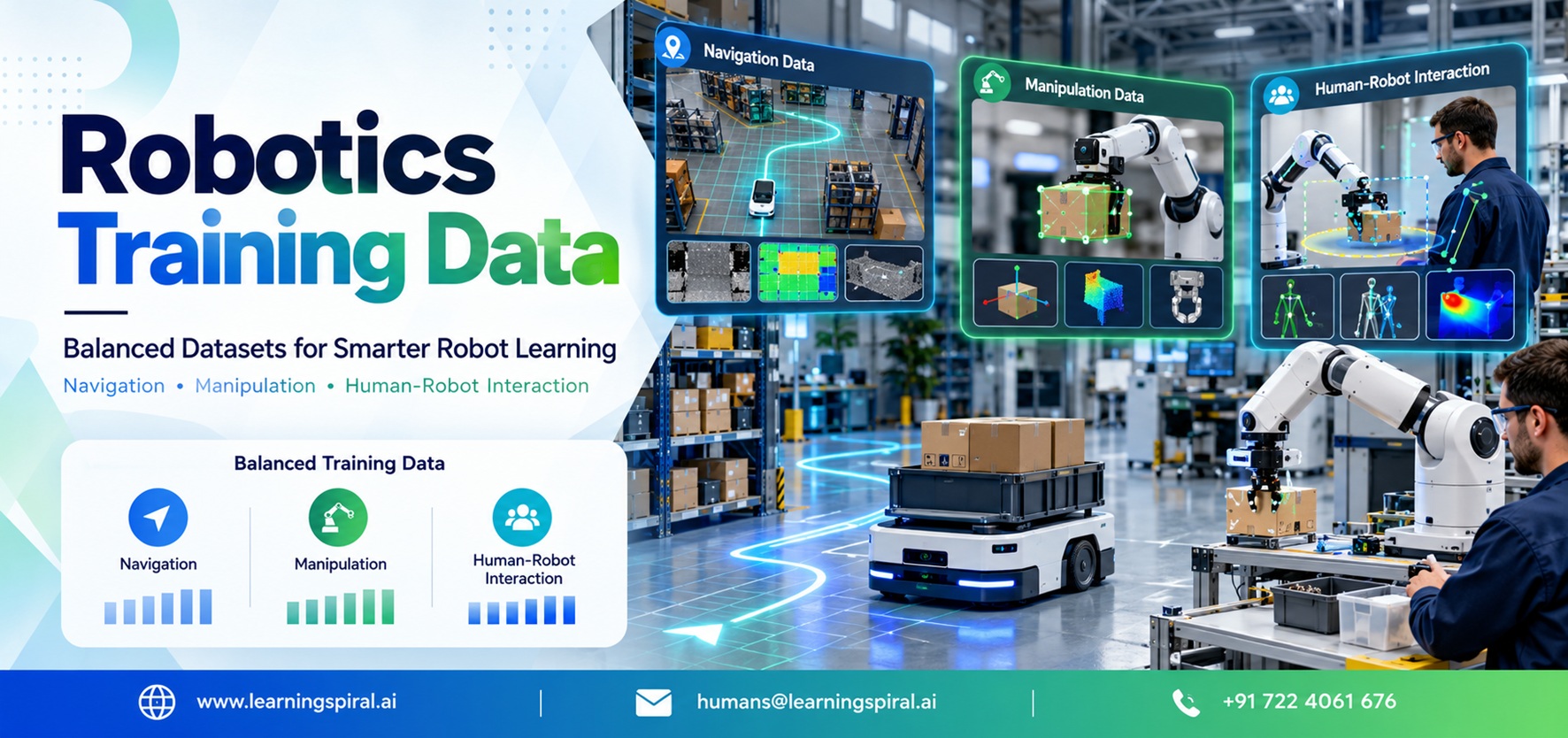
Modern robotics has evolved beyond rigid industrial arms bound to factory floors. Today, autonomous mobile robots (AMRs), humanoid assistants, and collaborative bots navigate dynamic environments, handle complex objects, and safely interact with humans. However, the backbone of these physical AI innovations isn’t just superior hardware—it’s high-quality, balanced robotics training data.
Without well-annotated, multi-modal datasets, a robot cannot perceive its environment, estimate object depth, or interpret human Intent. As a leading Data Annotation Company, Learning Spiral AI empowers global developers by providing precision AI Data Solutions tailored for physical robotics and computer vision models.
1. Autonomous Navigation: Precision Data for Spatial Perception
For a robot to navigate warehouses, dynamic sidewalks, or indoor environments autonomously, it requires continuous sensory awareness. Building datasets for navigation involves calibrating sensor streams from RGB cameras, LiDAR sensors, and radar.
- LiDAR Annotation & 3D Point Cloud Processing: Essential for spatial mapping, depth sensing, and multi-object tracking. Precise 3D point cloud annotation enables robots to detect obstacles in real time.
- Edge Cases & Environmental Balance: Training sets must account for varied lighting conditions, weather anomalies, dynamic shadows, and sudden occlusions to avoid localization failure.
- Semantic Segmentation: Labeling drivable paths, structural boundaries, and temporary hazards down to the exact pixel.
2. Robotic Manipulation: Bridging Vision and Physical Action
Navigating to a target is only half the battle; physical interaction requires dexterous manipulation. Whether picking items in e-commerce fulfillment or performing delicate surgical procedures, robots rely on robust computer vision and trajectory data.
- Grasp Point & Keypoint Detection: Annotating optimal contact points on dynamic, deformable, or transparent objects using bounding box annotation, polygon masks, and keypoint landmarks.
- Pose Estimation: Predicting 6-DOF (Degree of Freedom) positions so robotic arms can calculate precise approach angles.
- Egocentric Data Collection: Training robots using first-person perspective video data. Capturing first-person hand-object interactions drastically accelerates fine-motor manipulation skill acquisition.
3. Human-Robot Interaction (HRI): Ensuring Safe Collaboration
As robots work alongside humans in manufacturing, retail, and healthcare, safety and social awareness become paramount. Building balanced datasets for HRI demands multi-modal understanding.
- Human Pose & Movement Tracking: Using skeletal keypoint labeling to track operator gestures and predict trajectories to prevent collisions.
- Multi-Modal Perception: Integrating audio data annotation (voice commands), video analysis (gaze/intent), and gesture tracking to create intuitive interaction loops.
- Human in the Loop (HITL) Validation: Incorporating continuous human review to validate corner cases, flag biases, and re-annotate failure modes in real-world deployment settings.
Overcoming Data Imbalance in Robotics AI Models
A primary failure mode in deployment is dataset bias—when a model performs exceptionally in standard test scenarios but fails under rare conditions. To achieve reliable performance, enterprise teams require comprehensive data annotation services covering diverse scenarios:
- Diverse Lighting & Weather Conditions: Daylight, night-time, rain, and fog simulations.
- Deformable & Unstructured Objects: Liquids, flexible textiles, and irregular organic items.
- Varied Human Demographics & Behaviors: Unexpected pedestrian movements, varied uniforms, and complex gestures.
Partnering with specialized Data Labeling Companies in India like Learning Spiral AI guarantees scale, data security, and high accuracy through human-managed annotation pipelines.
Scale Your Robotics AI Models with Learning Spiral AI
Building reliable physical AI models demands more than raw data—it requires structured, multi-modal, highly accurate datasets for machine learning. At Learning Spiral AI, our dedicated annotators deliver customized Image Annotation for Robotics, 3D LiDAR labeling, and video annotation solutions tailored to your unique architecture.
