

Every successful AI model starts with one thing: good data. But raw data alone is not enough. A self-driving car cannot recognise a pedestrian, a chatbot cannot detect sentiment, and a medical AI cannot spot an anomaly unless the data it learns from has been carefully labeled first.
That is where data labeling for machine learning comes in. In this guide, we explain what data labeling is, the main types of annotation, a practical workflow for building model-ready datasets, and how to choose the right data labeling company for your project.
What Is Data Labeling in Machine Learning?
Data labeling (also called data annotation) is the process of adding meaningful tags to raw data such as images, video, text, audio or 3D scans, so that a machine learning model can learn from it. These tagged examples are known as labeled data, and they act as the “ground truth” your model learns from.
Most real-world AI systems rely on supervised learning, where a model learns patterns from labeled examples and then makes predictions on new, unseen data. If the labels are wrong or inconsistent, the model learns the wrong lessons. This is why teams often say: garbage in, garbage out.
Why Quality Data Labeling Matters for AI Projects
- Higher model accuracy: Clean, consistent labels directly improve prediction quality.
- Faster development: Well-prepared datasets reduce retraining cycles and rework.
- Lower bias: Diverse, carefully reviewed data helps reduce unfair or skewed outcomes.
- Scalability: A structured labeling process lets you grow from a pilot to millions of data points.
For any dataset for machine learning, labeling quality often matters more than dataset size.
Types of Data Annotation Services
Different AI use cases need different annotation methods. Here are the most common ones.
1. Image Annotation and Image Labeling
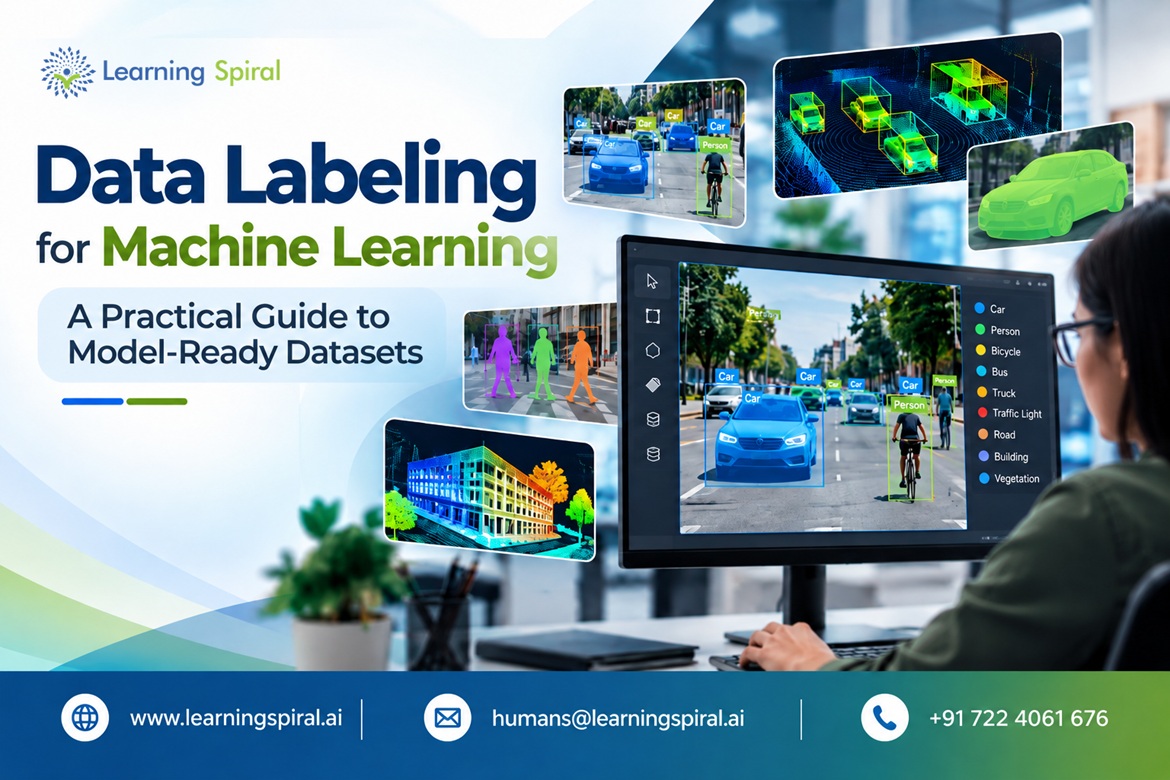
Image annotation is the backbone of computer vision. Common techniques include bounding box annotation, polygon annotation, keypoint and skeletal annotation, and semantic segmentation. Professional image annotation services help models detect, classify and locate objects accurately.
Popular use cases:
- Autonomous vehicles: vehicles, lanes, signs and pedestrians
- Retail: shelf monitoring and product recognition
- Agriculture: crop health, weed and pest detection
- Logistics: package detection and warehouse automation
- Aerial imagery: drone and satellite image analysis
- Sports and games: player tracking and action recognition
2. Video Annotation
Video annotation tracks objects and actions frame by frame. It supports surveillance analytics, motion tracking, sports analysis and driver-assistance systems.
3. 3D Point Cloud and LiDAR Annotation
Autonomous systems, robots and smart-city applications depend on depth and spatial data. LiDAR annotation and 3D point cloud annotation label objects in three-dimensional space. Our LiDAR and 3D annotation work helps machines understand distance, shape and movement in real environments.
4. Text Annotation
Text annotation powers NLP models and LLM training. It includes named entity recognition, intent classification and sentiment analysis. With text annotation in multiple languages, chatbots and search engines can understand context far better.
5. Audio Annotation
Audio annotation covers transcription, speaker identification, sound-event tagging and emotion detection. It is vital for voice assistants and speech recognition.
6. Medical Data Annotation
Medical annotation supports diagnostic AI by labeling X-rays, CT scans, MRIs and pathology images. It demands domain-aware annotators and strict data security.
7. Content Moderation
Content moderation labels and classifies user-generated content, such as text, images and video, so platforms can detect harmful or policy-violating material at scale.
Emerging Needs: Physical AI, Robotics and Egocentric Data
AI is moving beyond screens into the physical world. Robots, wearables and smart devices need Physical AI data collection, egocentric data collection (first-person video captured from a wearer’s viewpoint) and image annotation for robotics. These datasets teach machines how humans interact with real objects and spaces, which makes them a fast-growing area of AI training data services.
A Practical Workflow for Preparing Model-Ready Datasets
Here is a step-by-step approach any ML team can follow.
Step 1: Define the objective.
Decide exactly what your model must predict. A clear goal determines the label types you need.
Step 2: Collect relevant raw data.
Gather diverse, representative data that matches real-world conditions, including edge cases and different lighting, accents, languages or environments.
Step 3: Write clear annotation guidelines.
Create a labeling manual with definitions, examples and edge-case rules. Clear guidelines are the single biggest driver of consistency.
Step 4: Choose the right tools and annotators.
Select annotation tools that fit your data type, and assign trained annotators who understand your domain.
Step 5: Label with Human in the Loop (HITL).
Human in the Loop (HITL) combines automation with human review. AI-assisted pre-labeling speeds up the work, while human experts correct and validate the output.
Step 6: Apply multi-level quality control.
Use review layers, consensus checks and sampling audits. A dedicated quality control process catches errors before the data reaches your model.
Step 7: Export in the right format.
Deliver the dataset in formats such as COCO, JSON, XML or CSV so your engineers can plug it straight into training.
Step 8: Iterate based on model performance.
Test the model, find where it fails, and label more data for those cases. Good datasets are improved continuously.
Common Data Labeling Mistakes to Avoid
- Starting without written guidelines
- Using too little data variety
- Skipping quality checks to save time
- Ignoring data privacy and security
- Treating labeling as a one-time task instead of an ongoing process
How to Choose a Data Annotation Company
Whether you are comparing data labeling companies in India or looking worldwide, check these points:
- Domain expertise across image, video, text, audio, LiDAR and medical data
- Quality assurance with clear accuracy-measurement processes
- Data security such as ISO 27001-compliant operations
- Scalability to handle both pilots and large data annotation projects
- Trained in-house teams rather than anonymous crowds
- Transparent pricing and a free pilot so you can test quality first
Why Learning Spiral AI Is a Trusted Data Annotation Partner
Learning Spiral AI is a data annotation and data labeling company in India that delivers data labeling and annotation services for AI and computer vision teams. Here is what sets us apart:
- ✅ 15+ years of experience handling sensitive data at scale
- ✅ Trained, in-house, dedicated annotation teams
- ✅ ISO 27001-compliant delivery with a strong focus on data security
- ✅ Human-in-the-loop workflows with multi-level quality checks
- ✅ End-to-end AI data solutions across image, video, LiDAR, text, audio, medical and content services
- ✅ Support for autonomous vehicles, robotics, retail, agriculture, logistics, aerial and sports use cases
Frequently Asked Questions
What is data labeling in machine learning?
It is the process of tagging raw data, such as images, text, audio or video, so that machine learning models can learn from it.
What is the difference between data labeling and data annotation?
The two terms are mostly used interchangeably. Annotation sometimes implies richer, more detailed markup, but both prepare data for model training.
How much labeled data do I need?
It depends on model complexity and use case. Start with a small, high-quality pilot, measure results, then scale.
Which industries use data annotation the most?
Autonomous vehicles, healthcare, retail, agriculture, logistics, robotics, security and sports analytics are major users.
Can Learning Spiral AI handle large annotation projects?
Yes. Our trained teams and structured quality workflows support both small pilots and large-scale data annotation projects.
Final Thoughts
Great AI is built on great data. By following a clear workflow, writing strong guidelines and using human-in-the-loop quality checks, you can turn raw data into reliable, model-ready datasets. If you want an experienced partner to do it for you, our team is ready to help.
