

Language diversity is one of the biggest challenges for AI systems in speech recognition and natural language processing (NLP). Variations in dialects and accents can significantly impact model accuracy, leading to misunderstandings or misclassifications. Enterprises often underestimate the impact of inconsistent labeling on AI performance.
Learning Spiral AI has years of experience in creating high-quality, manually labeled datasets, ensuring that AI models understand subtle linguistic variations with precision. “At Learning Spiral AI, our annotation pipelines consistently help clients achieve over 95% model accuracy across complex AI use cases,” says our senior data scientist.
Manual labeling remains the gold standard for training AI models where nuance is critical. While automated solutions exist, only expert human annotators can reliably differentiate accents, regional pronunciations, and dialect-specific vocabulary.
Challenges in Labeling Dialects and Accents
Creating datasets for dialects and accents involves unique obstacles:
-
Subtle Pronunciation Differences: Small changes in vowel or consonant sounds can alter meaning, requiring careful annotation.
-
Regional Vocabulary Variations: Words can differ regionally while having the same meaning, making context critical.
-
Speaker Diversity: Age, gender, and speech speed introduce additional complexity.
-
Consistency Across Large Datasets: Scaling annotations while maintaining accuracy is difficult without a trusted workflow.
Learning Spiral AI addresses these challenges with proven workflows and trained linguists, ensuring datasets are both accurate and scalable.
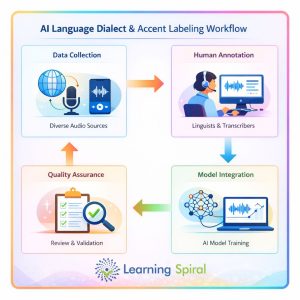
Manual Annotation Process at Learning Spiral AI
A structured, human-driven approach ensures that every dataset meets enterprise-grade standards. Our process includes:
-
Data Collection & Preprocessing
-
Curating diverse audio sources to capture regional dialects and accent variations.
-
Removing noise and standardizing file formats for annotation readiness.
-
-
Expert Human Annotation
-
Linguists label dialects, accents, and phonetic nuances.
-
Multi-level quality checks to eliminate errors.
-
-
Quality Assurance & Validation
-
Cross-reviewing by senior annotators to maintain dataset consistency.
-
Sample testing with ML models to verify annotation effectiveness.
-
-
Dataset Delivery & Integration
-
Structured datasets delivered in formats compatible with NLP and speech recognition pipelines.
-
Continuous support for updates and expansion as AI models evolve.
-
Benefits of Manual Dialect & Accent Labeling
High-quality manual annotation drives measurable business outcomes:
-
Improved AI Model Accuracy: Reduces misclassification, boosting user satisfaction.
-
Enhanced NLP Applications: Accurate sentiment analysis, chatbots, and transcription.
-
Scalable Enterprise Solutions: Flexible annotation pipelines support large datasets.
-
Trustworthy & Compliant Data: Ensures adherence to privacy and security standards.
Applications Across Industries
Enterprises leveraging precise dialect and accent annotation see benefits across sectors:
| Industry | Use Case | Impact |
|---|---|---|
| E-commerce | Voice search and customer support | Improved customer experience and conversion |
| Healthcare AI | Transcription of patient notes | Reduced errors in patient records |
| Automotive AI | Voice-controlled systems in vehicles | Enhanced safety and accessibility |
| Telecom & Media | Automated subtitling and transcription services | Accurate content delivery |
Learning Spiral AI ensures customized annotation pipelines to suit each enterprise’s domain requirements.
Best Practices for Manual Dialect Annotation
To achieve optimal results, Learning Spiral AI follows key best practices:
-
Standardize labeling conventions across annotators.
-
Provide detailed dialect and accent guidelines for human annotators.
-
Implement continuous quality monitoring with ML-assisted checks.
-
Keep the dataset up-to-date with evolving language trends.
By following these practices, Learning Spiral AI guarantees enterprise-ready, precise, and scalable datasets that deliver consistent AI performance.
Conclusion
Manual labeling of language dialects and accents is critical for high-performing AI models. Learning Spiral AI combines expert linguists, proven annotation workflows, and enterprise-grade quality assurance to deliver trustworthy, scalable, and precise datasets.
“Unlock your AI’s true potential with Learning Spiral AI’s expert dialect and accent annotation services—get started today.”
