

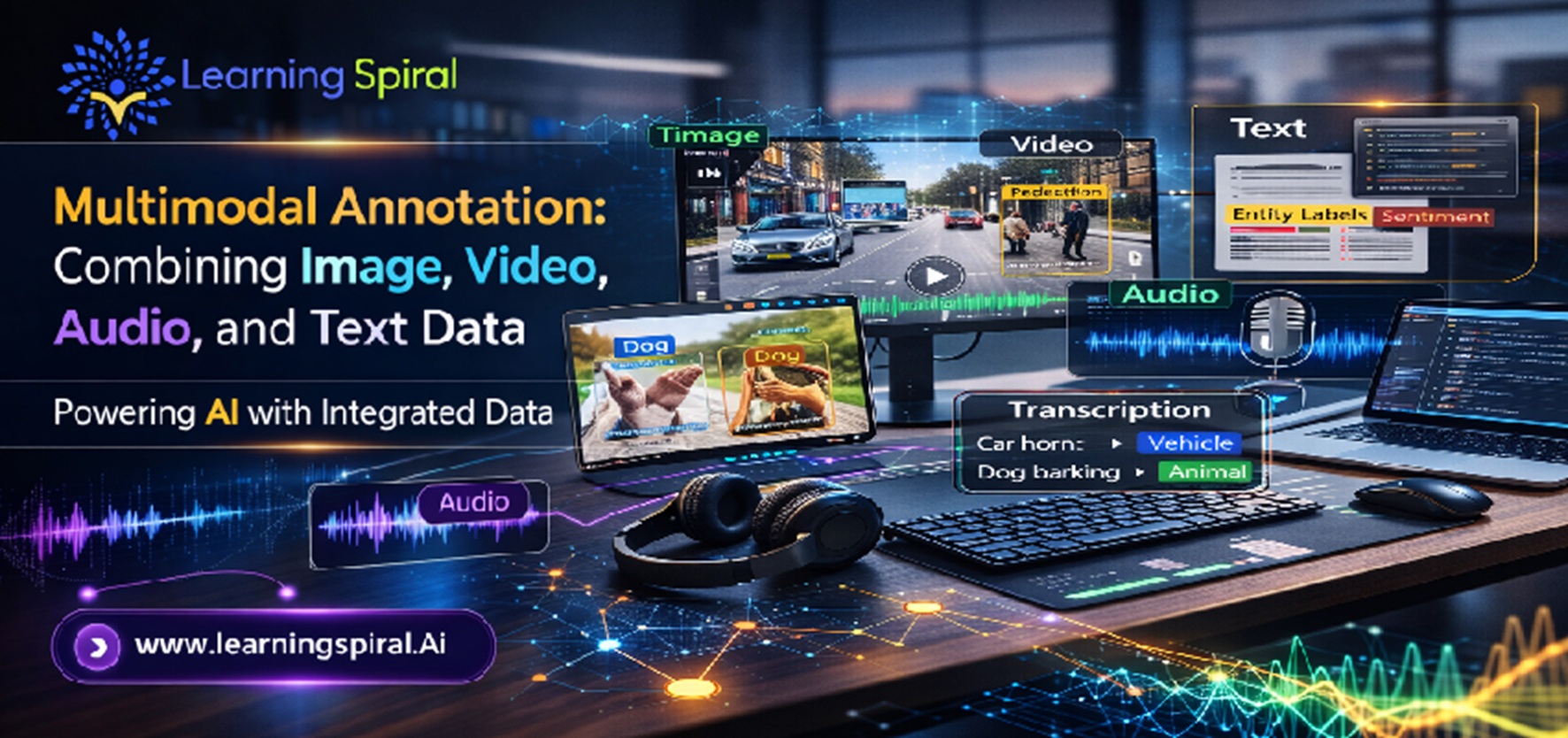
An autonomous robot sees a worker reaching for a tool. A camera captures the movement. A microphone records the worker saying, “Pass me the wrench.” A transcript identifies the instruction, while sensor data records where the robot and tool are located.
To a human, these signals form one event.
To an AI model trained on disconnected datasets, however, they may look like completely unrelated pieces of information.
That gap is exactly what multimodal data annotation is designed to solve.
Instead of labeling image, video, audio, and text data independently, multimodal annotation creates structured relationships between different forms of data so artificial intelligence can understand an event with significantly richer context.
It is becoming increasingly important for generative AI, robotics, autonomous systems, conversational AI, healthcare, content moderation, retail intelligence, Physical AI, and next-generation machine learning systems.
What Is Multimodal Data Annotation?
Multimodal data annotation is the process of labeling and connecting information from two or more data modalities, such as images, videos, audio recordings, text, LiDAR scans, or other sensor data.
Traditional annotation might teach an AI model:
- what appears inside an image,
- what action occurs in a video,
- what was spoken in an audio recording, or
- what a sentence means.
Multimodal annotation goes one step further.
It teaches the system how those signals relate to one another.
For example, imagine a short retail video where a shopper picks up a red shoe and asks:
“Do you have this in size 9?”
A multimodal dataset could contain:
- A bounding box identifying the shoe.
- Video tracking following the shopper’s hand.
- Audio transcription of the question.
- Text annotation identifying the intent as a product availability query.
- Product metadata connecting “this” with the red shoe visible in the video.
Instead of learning from five disconnected labels, an AI model receives one context-rich representation of the real interaction.
This closely relates to multimodal learning, where machine learning systems process multiple forms of information to develop a broader understanding of an event.
Why Single-Modality Training Data Is Often Not Enough
Real-world interactions are rarely limited to only one form of information.
Humans naturally combine vision, language, sound, movement, position, and environmental context.
AI systems increasingly need to do the same.
Consider a delivery robot approaching a busy crossing.
An image can reveal a pedestrian.
Video can reveal that the pedestrian is moving toward the road.
Audio may capture a vehicle horn.
LiDAR can estimate the pedestrian’s distance.
Text or map information can explain the surrounding traffic rules.
Individually, each signal is useful.
Together, they provide something far more valuable: context.
This is why companies developing sophisticated AI increasingly require high-quality Data Annotation Company workflows capable of handling multiple data types under consistent annotation guidelines.
The Four Core Modalities of Multimodal Annotation
1. Image Annotation: Teaching AI What It Sees
Images remain one of the most important sources of training data for computer vision.
Professional Image Annotation Services can include:
- Bounding box annotation
- Polygon annotation
- Semantic segmentation
- Instance segmentation
- Keypoint annotation
- Image labeling
- Object classification
- Landmark annotation
Image annotation enables models to locate, identify, classify, and understand objects or regions within visual data.
Its applications extend across image annotation for autonomous vehicles, image annotation for agriculture, image annotation for retail, image annotation for logistics, image annotation for sports and games, image annotation for aerial imagery, Medical Data Annotation, and Image Annotation for Robotics.
For multimodal AI, visual labels can later be connected with spoken descriptions, textual instructions, actions, sensor readings, and environmental events.
2. Video Annotation: Adding Movement and Time
An image tells AI what exists at one moment.
Video tells AI what happens next.
Video Annotation introduces a temporal dimension through techniques such as:
- Object tracking
- Action labeling
- Event detection
- Frame-by-frame annotation
- Activity recognition
- Temporal tagging
- Human pose tracking
Suppose an industrial worker reaches toward a machine.
A single frame might indicate only the position of the person’s hand.
Video annotation can show that the hand moves toward a control panel, presses a button, and then moves away.
When that sequence is synchronized with spoken instructions and sensor readings, the training data becomes far more meaningful for robotics and Physical AI.
3. Audio Annotation: Teaching Machines to Hear Context
Audio data contains information that cameras cannot capture.
Audio Annotation can identify:
- Speech
- Speakers
- Keywords
- Background sounds
- Emotion
- Intent
- Acoustic events
- Start and end timestamps
Audio Data Annotation is critical for speech recognition, conversational AI, call analytics, smart assistants, automotive interfaces, accessibility systems, security monitoring, and multimodal LLM applications.
Imagine an AI system watching a factory worker.
Video may show the worker stepping backwards, while audio simultaneously captures the words “Stop the machine.”
Connecting those signals enables the model to learn that speech, movement, and the surrounding event are related.
4. Text Annotation: Giving Language Structure and Meaning
Text gives AI another powerful source of context.
Text Annotation may involve:
- Named entity recognition
- Intent recognition
- Sentiment Analysis
- Topic classification
- Keyword tagging
- Relationship extraction
- Text categorization
- Question-answer labeling
- LLM response evaluation
Text Data Annotation is particularly important for natural language processing, chatbots, search systems, recommendation engines, generative AI, LLM development, customer analytics, and Content Moderation.
Within a multimodal dataset, text may describe an image, represent the transcript of an audio recording, explain an activity in a video, or provide instructions linked to a physical action.
The Real Challenge: Cross-Modal Alignment
Simply having image, video, audio, and text annotations in the same dataset does not automatically make it a good multimodal dataset.
The real value comes from alignment.
Annotations need to indicate which pieces of information belong together.
For example:
Video: A technician reaches for a screwdriver.
Audio: “Tighten the upper screw.”
Text label: Intent = assembly instruction.
Image annotation: Bounding box = screwdriver.
Keypoint annotation: Right hand = interacting with screwdriver.
Timestamp: 00:14.2–00:17.8.
A correctly aligned dataset connects all of these labels to the same event.
Without accurate timing, object identity, semantic relationships, and consistent identifiers, a multimodal model may learn incorrect associations.
High-quality labeled data therefore matters not only at the individual-label level but also at the relationship level.
How a Multimodal Annotation Workflow Works
A scalable multimodal annotation project generally follows a structured process.
Step 1: Define the AI Objective
The team must first determine what the model is expected to understand.
Is it identifying an object?
Following instructions?
Recognizing emotional intent?
Tracking actions?
Navigating an environment?
Generating descriptions?
Answering questions about visual content?
The AI objective determines what needs to be annotated.
Step 2: Map Every Available Data Modality
The project may contain:
- Images
- Video
- Audio
- Text
- LiDAR Annotation
- 3D Point Cloud Annotation
- Sensor information
- Metadata
- GPS or spatial signals
Understanding these modalities prevents teams from designing isolated annotation pipelines.
Step 3: Create a Unified Annotation Ontology
The same object, action, person, event, or entity should have consistent meaning across modalities.
For example, a vehicle labeled “car” in an image should not unexpectedly become “automobile_01” in LiDAR data and “sedan” in text unless the ontology explicitly defines those relationships.
Step 4: Annotate Each Modality
Specialized annotators label each data type using task-specific methods such as bounding boxes, segmentation, transcription, entity tagging, sentiment classification, event annotation, or 3D cuboids.
Step 5: Synchronize the Modalities
Visual frames, speech segments, text transcripts, and sensor readings must be connected using timestamps, identifiers, relationships, or metadata.
This synchronization is one of the most important stages of multimodal annotation.
Step 6: Apply Human in the Loop Quality Assurance
Automation can accelerate annotation, but ambiguous relationships still require human judgment.
Human in the Loop (HITL) workflows allow trained reviewers to inspect uncertain predictions, edge cases, cross-modal inconsistencies, and complex contextual relationships.
Human feedback is particularly valuable in medical annotation, sentiment interpretation, LLM evaluation, content moderation, robotics, and safety-critical AI applications.
Step 7: Validate the Dataset Before Training
Before delivering a Dataset for Machine Learning, teams should validate:
- Label consistency
- Timestamp synchronization
- Object IDs
- Missing modalities
- Annotation accuracy
- Ontology compliance
- Edge cases
- Cross-modal relationships
This quality-control layer helps prevent annotation errors from becoming model errors.
Where Multimodal Annotation Is Creating Real Business Value
The applications extend far beyond experimental multimodal AI.
1. Robotics and Physical AI
Modern robots increasingly combine cameras, microphones, depth sensors, LiDAR, written instructions, and action sequences.
Physical AI Data Collection, Egocentric Data Collection, Image Annotation for Robotics, Video Annotation, action labeling, keypoints, and 3D Point Cloud Annotation can collectively teach robots how people interact with tools, machinery, environments, and other humans.
2. Autonomous Vehicles
Autonomous systems may combine cameras, LiDAR, radar, maps, video, and telemetry.
Image annotation for autonomous vehicles identifies road users and infrastructure, while LiDAR Annotation helps establish depth and 3D position.
Aligned sensor data can help AI understand not simply that a pedestrian exists, but where that pedestrian is, how they are moving, and whether they are entering the vehicle’s path.
3. Healthcare AI
Medical Data Annotation can combine scans, images, physician notes, reports, speech, clinical records, and other medical information.
Multimodal systems can potentially analyze visual observations alongside related language and patient information, making accurate alignment and expert review essential.
4. Retail and E-commerce
Retail AI increasingly works with product photos, videos, customer queries, voice searches, reviews, catalog descriptions, and behavioral signals.
Image annotation for retail can identify products and attributes, while Text Annotation and Sentiment Analysis help systems interpret intent, feedback, and customer language.
5. Logistics and Warehousing
Image annotation for logistics, barcode labeling, package detection, video tracking, OCR, spatial data, and sensor signals can support intelligent inventory, automated warehouses, package tracking, and robotic fulfillment.
6. Sports and Games
Image annotation for sports and games, player tracking, keypoints, Audio Annotation, commentary transcripts, and event tagging can power automated highlights, performance analytics, tactical analysis, and searchable sports content.
7. Content Moderation
A post that appears harmless as text may have a completely different meaning when combined with an image, video, or audio clip.
Multimodal Content Moderation allows AI systems to assess the complete piece of content rather than evaluating each component independently.
Multimodal Annotation and the Growth of LLMs
The next generation of LLM and generative AI systems increasingly goes beyond text.
Models are expected to interpret images, understand video, process spoken language, reason about documents, and connect information across several modalities.
That requires training data where relationships are explicit.
A model should be able to understand that:
- a phrase refers to an object in an image,
- a spoken instruction corresponds to an action in a video,
- a question refers to a particular document section,
- an audio event occurs at a particular moment,
- or a physical action corresponds to sensor observations.
This makes scalable AI Training Data Services and well-designed Data Labeling Services increasingly important for advanced AI development.
Common Challenges in Multimodal Data Annotation
Multimodal Annotation Projects introduce complexity that traditional annotation projects may not encounter.
1. Synchronization Errors
A two-second mismatch between video, audio, and labels may associate speech with the wrong action.
2. Inconsistent Label Definitions
Different annotation teams may interpret the same entity differently unless a shared ontology is used.
3. Complex Context
A statement may be impossible to label accurately without seeing the related image or hearing the associated audio.
4. Large Data Volumes
Video, high-resolution images, audio, and 3D Point Cloud Annotation can create enormous datasets requiring scalable infrastructure and carefully managed workflows.
5. Specialized Domain Knowledge
Medical annotation, autonomous systems, robotics, and technical industrial data may require annotators with relevant domain knowledge.
6. Quality Across Modalities
A dataset is only as dependable as the relationships connecting its different components.
Accurate individual annotations cannot compensate for poor cross-modal alignment.
Why Human Expertise Still Matters
AI-assisted annotation can improve speed, but multimodal datasets frequently contain ambiguity.
A model might confidently recognize a tool in an image while misunderstanding which tool a speaker actually refers to.
It may transcribe a sentence correctly while misinterpreting its intent.
It may detect a person correctly but incorrectly associate that person’s action with another event.
Human reviewers can evaluate the complete context and correct these relationships.
This is why Human in the Loop workflows remain highly valuable for sophisticated Data Annotation Projects.
Building Multimodal AI Datasets with Learning Spiral AI
Learning Spiral AI supports organizations that require scalable data labeling & annotation services for complex AI development.
Our annotation capabilities span:
- Data Annotation
- Data Labeling
- Image Annotation
- Video Annotation
- Audio Annotation
- Text Annotation
- Bounding Box Annotation
- Semantic segmentation
- Image Labeling
- Sentiment Analysis
- LiDAR Annotation
- 3D Point Cloud Annotation
- Medical Annotation
- Content Moderation
- Human in the Loop workflows
- AI Training Data Services
- Dataset for Machine Learning development
Whether your Annotation Projects involve Computer Vision, an LLM, autonomous systems, healthcare, retail, logistics, agriculture, robotics, or Physical AI, the goal remains the same:
turn complex real-world information into structured, model-ready data that AI can understand.
For organizations evaluating an Annotation Company for AI, choosing a partner capable of managing multiple data types under consistent guidelines can significantly simplify the training-data pipeline.
The Future of AI Is Multimodal
AI is moving closer to the way humans understand the world.
We do not experience reality as separate image, audio, video, and text streams.
We combine what we see, hear, read, remember, and observe to understand context.
Multimodal AI is moving in the same direction.
But models cannot learn those relationships from raw data alone.
They need accurately labeled, carefully synchronized, context-rich training datasets.
That is why multimodal data annotation is becoming a critical foundation for the next generation of intelligent systems.
Better multimodal data creates stronger context.
Stronger context enables better learning.
And better learning helps build AI systems capable of understanding the real world with greater reliability.
Frequently Asked Questions
What is multimodal data annotation?
Multimodal data annotation is the process of labeling and connecting multiple data formats such as image, video, audio, text, LiDAR, or sensor data so AI models can learn relationships across them.
How is multimodal annotation different from traditional data annotation?
Traditional data annotation may label each data type independently. Multimodal annotation also aligns objects, actions, speech, text, timestamps, and other signals so a model understands their combined context.
Which AI applications need multimodal annotation?
Robotics, autonomous vehicles, Physical AI, generative AI, LLMs, healthcare AI, retail intelligence, logistics, conversational AI, content moderation, sports analytics, and human-computer interaction can benefit from multimodal datasets.
Why is Human in the Loop important for multimodal data?
Humans can review ambiguous relationships and contextual information that automated tools may misinterpret, helping improve consistency and accuracy across modalities.
What types of data can Learning Spiral AI annotate?
Learning Spiral AI supports image, video, audio, text, LiDAR, 3D point cloud and other AI training data requirements through scalable annotation and quality-control workflows.
