

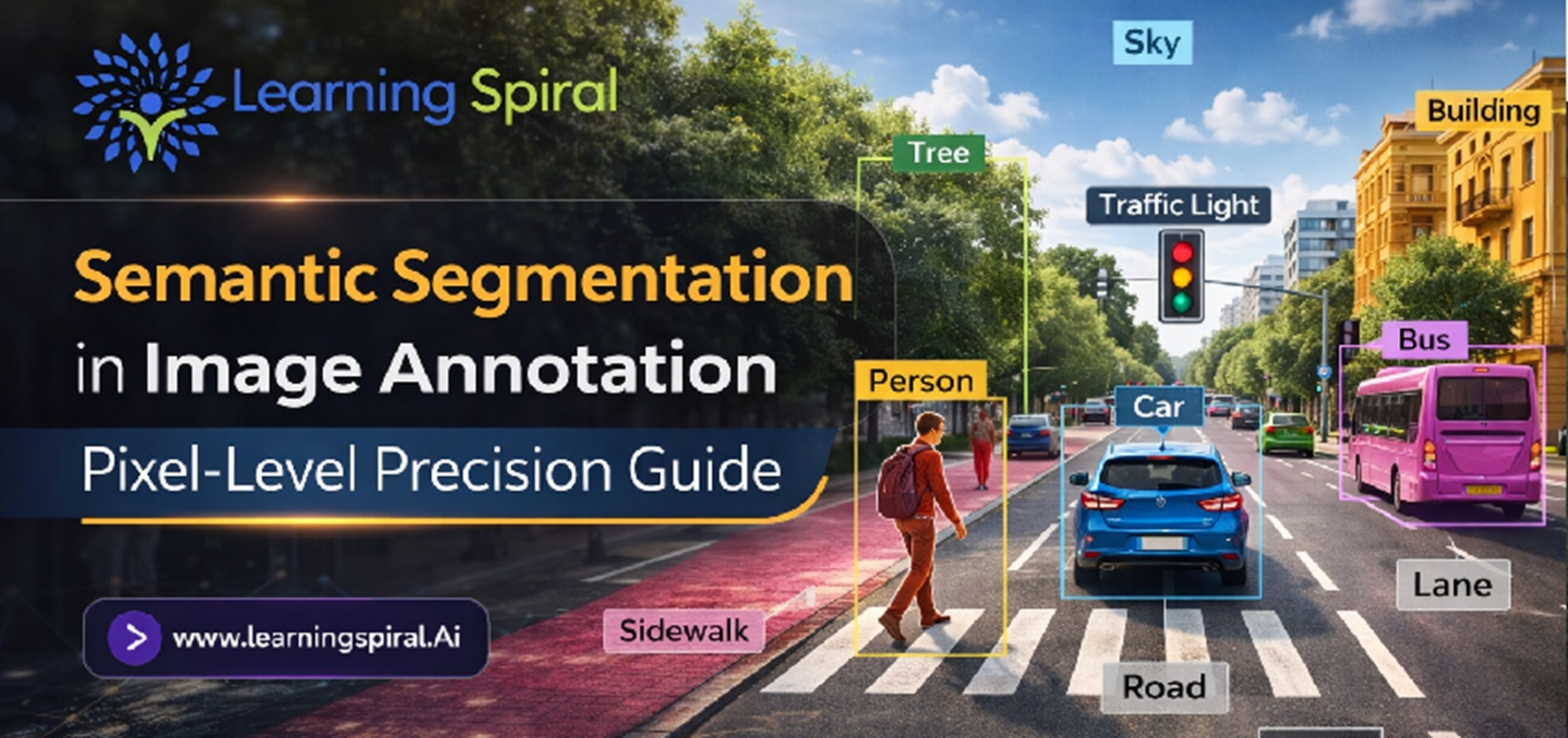
What Is Semantic Segmentation, Really?
Unlike bounding boxes that draw a rough rectangle around an object, semantic segmentation classifies every single pixel in an image into a category—road, pedestrian, sky, tumor, defect, and so on. This pixel-level precision is what allows Computer Vision models to understand scenes the way humans do: with context, boundaries, and depth.
For industries like autonomous driving, medical imaging, agriculture, and retail, this level of detail isn’t a luxury—it’s the baseline requirement for models that need to make real-world decisions safely.
Why Precision at the Pixel Level Matters
- Autonomous vehicles need to distinguish a pedestrian’s exact silhouette from the sidewalk, not just an approximate box
- Medical imaging relies on precise tumor or organ boundaries for accurate diagnosis
- Manufacturing quality control depends on identifying defects down to the pixel to avoid false negatives
A single mislabeled boundary can quietly degrade model performance across thousands of predictions. This is why Image Annotation Services built around rigorous quality control workflows matter more than raw annotation volume.
The Annotation Workflow Behind Great Segmentation
Building high-quality segmented datasets typically involves:
- Class taxonomy design — defining clear, non-overlapping categories before annotation begins
- Multi-pass Data Labeling — combining human annotators with review layers to catch boundary errors
- Edge-case handling — occlusions, overlapping objects, and low-contrast regions need specialized guidelines
- Format standardization — ensuring outputs are compatible with common Machine Learning datasets and training pipelines
High-quality annotation is not just data—it’s the foundation of reliable AI systems.
Organizations working with experienced AI Data Solutions partners often see faster convergence and fewer post-deployment corrections, simply because the training data reflects real-world complexity from day one.
Beyond Images: A Multimodal Data Challenge
Segmentation rarely exists in isolation. Many computer vision pipelines also draw on Video annotation for temporal consistency, alongside Text annotation and Audio annotation for multimodal AI systems that combine visual, linguistic, and acoustic understanding.
Whether you’re building your first CV pipeline or scaling an existing one, working with a capable Data Annotation Company can significantly shorten the path from raw imagery to production-ready datasets. Explore Learning Spiral AI’s annotation services to see how structured, quality-first workflows support real-world AI deployment.
