

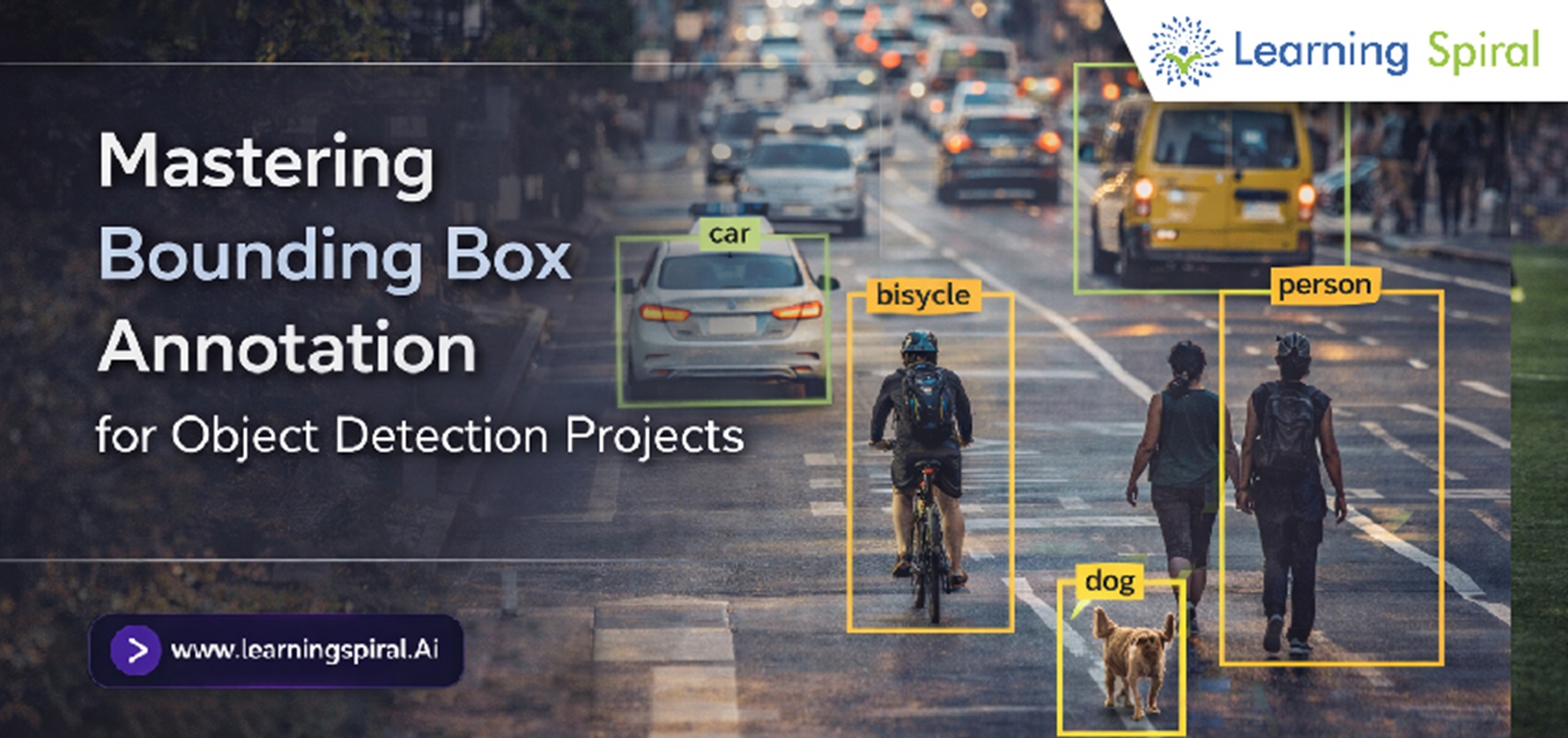
In the world of computer vision and machine learning datasets, the quality of your training data determines the ceiling of your model’s intelligence. And at the heart of most object detection pipelines lies one foundational technique: bounding box annotation.
What Is Bounding Box Annotation?
Bounding box annotation is the process of drawing rectangular boxes around objects of interest within an image or video frame. Each box captures the object’s location, size, and class label – giving your model the spatial context it needs to detect, localize, and classify real-world objects.
This technique is central to a wide range of AI applications, including:
- Autonomous vehicle perception and lane detection
- Retail inventory monitoring and shelf analytics
- Medical imaging for tumor or lesion localization
- Security and surveillance systems
- Industrial defect detection on production lines
Why Precision in Bounding Box Annotation Matters
Even small annotation errors—a box too loose or too tight – can cascade into poor model performance during training. When annotators are inconsistent or untrained, models learn faulty patterns that are expensive to correct later. That’s why organizations working with experienced AI data solution partners often achieve faster model accuracy and deployment timelines.
High-quality annotation is not just data—it’s the foundation of reliable AI systems.
Best Practices for Effective Bounding Box Labeling
1. Define Clear Annotation Guidelines
Every successful data labeling project starts with detailed, unambiguous instructions. What counts as a valid bounding box? How should partially occluded objects be handled? Clear guidelines reduce inter-annotator variability and improve consistency across large datasets.
2. Use Multi-Pass Quality Review
A robust quality assurance process—including automated checks and human review stages—ensures that annotations meet the accuracy thresholds your model demands. Teams that skip QA often discover labeling errors only after costly retraining cycles.
3. Scale With Purpose
Whether you need 10,000 or 10 million annotated frames, your image annotation services provider must be capable of scaling without compromising quality. Consistency at scale is what separates a good annotation partner from a great one.
Bounding Box Annotation Across Modalities
While bounding boxes are most common in static image datasets, they also apply to:
- Video annotation – tracking objects frame-by-frame for action recognition or traffic analysis
- Text annotation – entity tagging and span marking in NLP pipelines
- Audio annotation – timestamped event labeling for sound classification models
At Learning Spiral AI, our teams handle multi-modal data annotation—from computer vision tasks like bounding boxes and semantic segmentation to complex NLP and audio annotation workflows. Every dataset we deliver is built with model performance in mind.
Choosing the Right Data Annotation Company
When evaluating an AI data solutions provider, look beyond pricing. Consider their domain expertise, annotator training processes, quality assurance methodology, and track record with similar use cases. The right partner doesn’t just label data-they understand your model’s objectives and align every annotation decision to those goals.
Learning Spiral AI combines experienced annotation specialists with scalable infrastructure to deliver reliable, high-precision datasets across industries – helping AI teams move from prototype to production with confidence.
Conclusion
Bounding box annotation remains one of the most impactful and widely used techniques in supervised learning for computer vision. Getting it right requires more than tools – it requires expertise, process discipline, and a commitment to quality at every stage of the data pipeline.
| Ready to power your next AI model with precision-labeled training data?
Explore Learning Spiral AI’s image annotation services and discover how our scalable data solutions help you build smarter, faster. |
